I propose a variation on Godwin's Law. This would apply to the first person, who in commenting on a discussion about the deleterious effects of rising inequality , mentions North Korea.
Example:
"Worried about how the top few percent hold such a large proportion of society's wealth? I suppose you'd prefer to go and live in North Korea"
Sunday, July 31, 2011


Monday, July 18, 2011
Inconceivable
I don't know quite what to make of the fact that the Copa America semi-finals will feature Uruguay vs. Peru and Paraguay vs. Venezuela. There would have been long odds on favoured teams Colombia, Argentina, Brazil and Chile successively losing out to their opponents in the quarter-finals. The results came about in varying ways: from the epic Argentina-Uruguay match that neither team really deserved to lose, to the near-farce of the Brazil-Paraguay game where the Brazilians somehow failed to score in 120 minutes and then didn't convert any of their penalties.
All four of the winning sides were relatively pragmatic and unambitious, took their opportunities while their opponents squandered chances, and in the case of Uruguay and Paraguay, were helped through by the heroic goalkeeping performances.On the positive side, it's unpredictable, and means we avoid a third successive Brazil-Argentina final. On the negative side, it fuels arguments about the increasing mediocrity of international football. Negative tactics have been rewarded. None of the remaining sides (with the possible exception of Uruguay) have much charisma in footballing terms and most of the star players that were supposed to light up the tournament are gone, having failed to gel with their team mates and reproduce the form they show for their clubs.
In theory, Uruguay should win easily from here. But if we've learned anything so far, it's that the form book doesn't hold. For the record, I'm picking an easy 3-0 win for Uruguay over Peru, Paraguay to edge out Venezuela 1-0 with an ugly goal scrambled in from a free kick, then Uruguay and Paraguay to play out a dire 0-0 final. Who then wins on penalties? Well, I don't have a crystal ball.
For Their Own Benefit
If you take the Welfare Working Group at face value, their greatest concern is the well being of people on benefits, and their children. Its final report states:
Reducing the unacceptably high incidence of child poverty in New Zealand through a particular focus on risk jobless households and whanau must be a high priority of reform.
A lot is also made of the gains to self-esteem and dignity from being in paid work. Apart from the apparent futility of getting sole parents to organise and pay someone else to look after their children while they try to earn the same level of subsistence income, this is fair enough
But what it would take to help the majority of people struggling on benefits to get paid work? As the WWG acknowleges at different points, apart from child care, there's less punitive benefit abatement rates, education and skills training, more intensive individualised support for disabled people, drug rehabilitation, better public transport, help with the cost relocating to job-rich locations, and the list goes on.
The final report sums it up:
Reducing long-term benefit dependency requires an effective health system, an effective education system, adequate provision of affordable childcare, and the availability of suitable jobs. Social barriers to employment also need to be addressed, such as discrimination in the labour market and in the workplace against various groups including the long-term unemployed and disabled people. (p.54)
The problem is, all this doesn't square with the other stated concern of the WWG of reducing costs, nor with the assertion, backed by rather odd use of data in their Issues paper, that the current system is "unsustainable". If you were sincere about the doing the things required to support as many people as possible to get paid work, you'd need to consider that it might actually cost more.
Then there's the immense blind spot explained in passing by the fact that "our Terms of Reference precluded consideration of rates of payment in the welfare system". The WWG duly recognises that "children whose parents rely on income from the welfare system are at significantly higher risk of poverty" but assiduously avoids noting the obvious: you could address at least some of the problems suffered by the children of beneficiaries simply by making benefits less miserly.
Short of sending people to live under bridges, the current system, as flawed as it is, may actually be the cheapest option. If the idea is that we need to invest more to prevent people being left to rot, then I'm all for it. But given that the most specific WWG recommendations mainly involve things like making the higher payments for sickness and disability benefit discretionary, and inventing byzantine new "sanctions" regimes, one wonders if that is actually the plan.
Tuesday, July 12, 2011
Aconcagua Gear by Category #1
When I was preparing to climb Aconcagua, I had to make sure I had all the items on the Adventure Consultants gear list, and this meant getting quite a few things that I'd never had before. In doing the necessary research to find something that was right for me, I found the comments and reviews on various web sites to be very helpful. So here is where I return the favour. As promised, I'm going to go systematically through the categories of gear for Aconcagua to discuss what my experiences were and what I'd recommend. This post covers clothes. I make no apologies for mentioning brands and models, since in many cases their specific characteristics are important.
Trekking Clothes
For the trek in, I wore shorts-convertible synthetic trekking pants and a loose-fitting ultra-lightweight Icebreaker top. I regretted not having one of the trekking shirts recommended in the gear list, as despite my best efforts to wear my buff in the Foreign-Legion style and tie a spare t-shirt around my neck I struggled to keep the sun off my neck and upper sholders. I would highly recommend getting one of these.
Base Layers
The gear list recommended 2 thermal tops and 2 pairs of long underwear. There's a perennial debate about synthetic vs. merino: I come down firmly on the side of merino, but that's a whole other topic. Up the mountain, I took 150 and 200-weight Icebreaker Bodyfit tops and 150 and 260 Bodyfit long underwear. If you really wanted to be minimalist, you could probably get away with just one top and bottom. I shifted to the warmer pair after arriving at camp 1 and kept them on pretty much until we got off the mountain. But they don't weigh much and it's worth having a second pair as a backup.
Light fleece
The gear list recommended a light fleece as a second top layer. If you can get one, a Powerstretch type fleece is highly recommended, as this material fits easily with layers below and above it. Mine was an Arcteryx Rho AR. I put this on over the 200 Icebreaker at camp 1 and kept that combination on, day and night, until we got to Plaza de Mulas on the other side of the mountain some 9 or 10 days later.
Jackets
You need at least three and probably four jacket-type garments for warmth and weather protection.
You need a good Gore-Tex or equivalent jacket as the default outer layer for stopping all wind and precipitation. Mine was the Outdoor Research Furio, which worked out well. While some will prefer something nice and light, you want the jacket to be reasonably robust. It should be sized to fit comfortably over at least three layers (including the sleeves and the hood), and under pack straps. Some overlap with your pants is good, but the thigh-length jackets sometimes favoured by New Zealanders for the wet conditions here are not really appropriate for mountain climbing.
The other absolute esential is a warm down jacket. This provides your bastion of warmth while at camp on the lower mountain, and usually for at least the morning on the summit ascent. The Mountain Hardwear Sub Zero SL Hooded Jacket is perfect for Aconcagua, with just the right balance of warmth, weather resistance and packability. I was one of at least four on our expedition that had this exact jacket. You want to get the jacket, rather than the longer and more unwieldy parka model. On summit day, the down jacket needs to be worn over your Gore-Tex jacket. For this reason, and because it is cut short, if you are between sizes you should opt for the larger size.
The third jacket recommendation from Adventure Consultants was a "mid-weight jacket", but the specific examples they gave were a bit confusing. The listed options were an insulated soft shell such as the Marmot Super Hero, a 200 or 300-weight fleece or an insulated jacket like the Mountain Hardwear Compressor. These options all have rather different qualities and purposes. Based on my experience, I would strongly recommend the Compressor. What you are looking for here is a default source of warmth when your big down jacket would be too much or is stashed away. This is a jacket that goes over your trekking clothes at camp or long rest stops, and goes under your Gore-Tex jacket as a mid-layer higher up the mountain. The Compressor is about as warm as a 300-weight fleece, but much lighter and less bulky (if not very stylish -- in my green version I have been dubbed "Kermit the Frog").
The fourth jacket recommended by Adventure Consultants was a "wind shirt", such as the Marmot DriClime. This is actually what I'd call the "soft shell" category and is where I'd put the soft shell option mentioned above. This is a light, breathable and comfortable jacket that can be the outer layer in non-extreme conditions and a mid layer under the Gore-Tex jacket when wind and precpitation get out of hand. It will often have some light insulation and may have a hood. Strictly speaking, this is not obligatory, but you will be glad if you have one. I took the Arcteryx Gamma MX Hoody, and I wore this for about 60 percent of the whole trip (as well as large parts of the rest of my life). The great advantage of this jacket is its excellent fit as well as amazing appetite for abuse.
Pants
You need Gore-Tex pants as your main outer layer, and they must have a full zide zip so you can get them on and off over boots. I got the Outdoor Research Furio pants, the sibling to my jacket. These worked out well as I was fortunate enough that they fit me perfectly in both length and width (at least in the shape I was in during the climb). Some may prefer a bib or salopette, since these work with a roomier waist and the greater torso coverage provides extra warmth. This is a good option if you do lots of sking or snowboarding or are planning on doing more alpine climbing.
On Aconcagua you usually need insulated (not down) pants for summit day only. The default option here is the Mountain Hardwear Compressor, again the sibling of the jacket. These worked just fine, pack down very small and are easy to get on and off. I wore them for about the first half of summit day until it got too warm.
The gear list recommended fleece or soft shell pants. I'm not sure that anyone on the trip had fleece pants. I took a pair of MacPac Nemesis soft shell pants. I find these to be useful in intermediate conditions like climbing in Arequipa, but didn't really use them on this trip as we went pretty quickly from baking heat to very cold and snowy, so I switched straight from trekking pants to Gore-Tex. I thought I might combine the soft shell with the Gore-Tex pants for additional warmth, short of wearing the insulated pants, but never did so. If you really wanted to save space and weight, this is an item you could consider leaving out.
Thursday, July 07, 2011
Designer Facts
One of the variations on making shit up is rewriting history to suit your ideology; as Paul Krugman observes (with an appropriate nod to The Princess Bride):
I’ve often found that when things happen that aren’t supposed to happen according to the prevailing economic or political orthodoxy, reporting quite often describes what “should” have happened, not what actually happened.
New Zealand's economy and society is a common recipient of this treatment. Witness this article and interview with John Key in the Wall Street Journal:
Mr. Key is returning the country to a formula for prosperity that's worked in the past. As in Britain, the U.S. and Australia in the 1980s, New Zealand's government implemented a wide-ranging program of economic liberalization, including deep reductions in tariffs and subsidies, and privatization of state-run industries. The plan, nicknamed "Rogernomics" after then-Finance Minister (now Sir) Roger Douglas, was akin to Reaganomics, and the island nation grew smartly.
We often hear this story from those who argue for "further reforms". The only problem is that it happens to be false. New Zealand's premier economic historian Brian Easton identifes the 1986-1994 "Rogernomics recession" as one of the main places that New Zealand's economy fell behind Australia and the rest of the OECD (the others were the wool price crash of 1966, and he argues to a lesser exent the oil price shocks of the 1970s). Easton suggests that the culprits were high interest rates and a high exchange rate at the same time as much of New Zealand's productive sector was being dismantled. In any case, the 1986-94 dip is clearly visible on this chart.

The WSJ article continues:
But while the U.S. and Australia broadly continued their economic liberalization programs under both right- and left-wing governments, New Zealand didn't -- until now. Over the past nine years, Helen Clark's left-wing Labour government rode the global economic expansion and used the revenue surge to expand government welfare programs, renationalize industries, and embrace causes like global warming. As a result, the economy stagnated while Australia took off.
As you might have guessed, this also happens to be false. The chart above unfortunately ends in 2002, but you can see that New Zealand actually sees a slight uptick against both Australia and the OECD from 2000. Over the whole 1999-2008 period, New Zealand did a bit better than the OECD and was close to keeping pace with Australia, whose own economy boomed during this period. I can't lay my hands on the stats and charts I had bookmarked, but there's a nice presentation of the data in this post, from an Australian addressing some local scaremongering about MMP government.
That's before you get to the non-sequiturs in that paragraph from the WSJ. For example, I'm not clear what "used the revenue surge...to embrace causes like global warming" is supposed to mean. The renationalized "industries", which makes Helen Clark sound like Hugo Chavez, presumably refers to the reluctant rescue of Air NZ and the buy-back of Kiwi Rail. And it is something of a mystery how the Labour government could "use the revenue surge [while]...the economy stagnated".
It would be hilarious if wasn't so depressing.
Friday, July 01, 2011
The War on Welfare
As well as Gordon Campbell's piece that I linked to earlier on the continuing life of the Welfare Working Group, there was a well-researched piece from TimWatkin, and series of acerbic posts from Danyl McLaughlan, including an amusing suggestion for a reality TV show involving Paul Holmes
The take home point is that it's the economy, stupid. The Welfare Working Group sets an objective of getting 100,000 people off benefits. It's not hard to see how that might be achieved: just prior to the recession, in June 2008, there were 75,000 fewer people on benefits than there are now. At one point in 2008, the number on the unemployment benefit had dropped to 19,000. It's hard to square this, and the hundreds of people that line up for a chance at a few supermarket jobs, with the view that New Zealander's need more "incentive" to look for work.
Any perception of a recently developing crisis is inaccurate. As Watkin reports, the proportion of the working age population on benefits has been higher than it is today for most of the last twenty years. Yet in 1970 it was just four percent. What changed? Since the 1970s, the New Zealand economy has seen radical restructuring, notably through the liberalization of trade, downsizing of government and sale of many public assets. These changes significantly raised unemployment: for their advocates that was the price of economic efficiency. At the time, some pointed out that they wouldn't necessarily be socially efficient, but that quibble was lost in the winds of change.
The other major change in the 1970s was the introduction of the domestic purposes benefit. As Watkin says:
Given that it allowed women to get out of unhealthy, unhappy, even dangerous, relationships, I assume we think it's not a bad policy.
Again, the figures are hard to square with the certainty of talkback radio callers and Stuff website commenters that large numbers of [young] women are "breeding for a business". The Ministry of Social Development's helpful fact sheets report that just 10 percent of domestic purposes beneficiaries have been continuously on the benefit 10 years or more. Coincidentally, this is about the same as the percentage of domestic purposes beneficiaries who are male.
A number of critics have made the point that the miserly payment levels of the DPB hardly make for any sort of viable "business". Less well noted is the assmption (including by the WWG) that caring for children is not "work". Paid, no. Work, definitely. As somebody who now gets quite well paid for working, I never fail to appreciate that most days it ends at around 6pm.
The final third of benefit recipients are those on the sickness and disability benefits. Campbell points that out the percentage of working-age New Zealand receiving sickness and disability benefits is well below the OECD average, and the proportion of sick and disabled people in employment well above the OECD average.
In short, where work that offers subsistence level or above is available, New Zealanders generally take it. Most analyses conclude that there may be a hard core of recalcitrants, but if so, they consistute a small minority of beneficiaries. The question is not whether some proportion of welfare recipients are ripping off the system. but whether this is the most important issue facing the country at the moment. While the economy remains sluggish, and even high-skilled jobs continue to disappear on a weekly basis, forcing sole parents, the sick and the disabled to pound the pavements seems like the height of perversity.
Sunday, June 26, 2011
What's Happening in Football
The European club season and the Champions League are over (maybe some thoughts on those in another post), but football has far from shut down for the northern summer / southern winter, as now the international game takes centre stage.
There was a round of Euro 2012 qualifiers in June with another in September. Spain, Germany, Italy, and the Netherlands are already almost guaranteed qualification.
The UEFA U-21 European Championships have just concluded in Denmark, with a dominant Spain beating Switzerland 2-0 in the final, becoming first team to be World, European and European u-21 champions at the same time.
The CONCACAF Gold Cup (North American, Central American and Caribbean championship) has been played over the last couple of weeks. Predictably, the United States and Mexico have reached the final, to be played today.
The U-17 World Cup is being played at the moment in Mexico. After a 4-1 win over Uzbekistan in the opening game and a 0-1 loss to the Czech Republic, New Zealand have just played out a cagey 0-0 draw with the United States to go through to the last 16 for the second consecutive tournament. Unfortanately, in the second round they are likely to play Germany, who have scored 9 goals so far and must be one of the favourites for the whole tournament.
Next week, the Copa America (South American championship) begins in Argentina. Can the home team take its first senior trophy since 1993, to break the dominance of Brazil who have won four out of the past five tournament?
Finally, on 29 July the U-20 World Cup gets underway in Colombia. New Zealand is drawn in a tough group with Uruguay, Portugal and Cameroon. The 2015 U-20 World Cup will be held in New Zealand.
Tuesday, June 21, 2011
RIP Big Man
It was sad to hear yesterday that Clarence Clemons, best known as the saxophone player in Bruce Springsteen's E-Street Band, had passed away following a stroke, aged 69. Dubbed the "Big Man" by Springsteen, Clemons was the soul of the band, his powerful solos giving another dimension to songs such as "Thunder Road" (listen to the lead out at the end), "Rosalita", and of course "Jungleland".
There's a nice tribute on Salon from Wallace Stroby. The title of his piece is from the song "Tenth Avenue Freeze Out", where Springsteen describes how "the Big Man joined the band".
There's a nice tribute on Salon from Wallace Stroby. The title of his piece is from the song "Tenth Avenue Freeze Out", where Springsteen describes how "the Big Man joined the band".
Monday, June 20, 2011
Will to Power
My current TV addiction now that House, as one wit said, "has the shark swimming around in its tank", is The Good Wife (TV3, Sundays 10:25 pm). I've no idea how close it is to the reality of a large corporate law firm (though it must be closer than Boston Legal) or whether the election of state's attorney is really as big a deal as they make out. What I enjoy are the intricate webs of conflict, as every single character struggles to gain and consolidate status and power.
As a cronic conflict-avoider myself, I watch in a kind of fascinated horror as the power plays and one-upmanship unfold, even between characters that are broadly speaking friends or allies. One thing I've learned later in life is that conflict is unavoidably woven into the tapestry of human existence -- and that this isn't even necessarily all bad. But I guess I get a kind of carthasis watching a depiction of American big city law and politics, much more highly-charged than anything I'll have to deal with (I hope).
My guess at a general theme would be something like: even those who want to be moral, must also learn how to be ruthless.
Sunday, June 19, 2011
"Parapolitics" in Colombia
Hat-tip to Terence Wood for this must-read piece on Colombia from the New York Review of Books. The article, which reviews And They Refounded the Nation…: How Mafiosi and Politicians Reconfigured the Colombian State, edited by Claudia López Hernández, sums up what has emerged about the relationships between the political allies of former president Alvaro Uribe and right-wing paramilitary groups. It explains how the "justice and peace" process to demobilise paramilitaries under Uribe was a fraud, bearing most resemblance to the deal that drug lord Pablo Escobar tried to strike for himself in the 1990s. It documents the close links between Uribe's coalition and the paramilitaries, whose political and economic objectives were thoroughly interlinked with drug trafficking:
The paramilitary bosses who founded the AUC just over three years later were mostly former associates of Escobar. They had gotten their start as leaders of vigilante groups set up in the 1980s to deter guerrillas from kidnapping drug traffickers. These groups had joined forces with large landholders and, with the military’s support, expanded their operations from targeted retaliations to more widespread violence against suspected guerrilla allies, including leftist politicians and trade unionists.
By the 2000s, they had more systematic ambitions:
The paramilitaries had driven more than one million poor farmers off their lands, preparing the way for what the authors refer to as a “counter-agrarian reform.” Large landholders and investors—including paramilitaries and other traffickers—acquired the land, and corrupt officials helped them obtain title. As one former paramilitary put it: “We went in killing, others followed buying, and the third group legalized.”
Gradually emerging evidence has undermined the "democratic" credentials of Uribe, from revelations about the collaboration of members of his congressional allies with paramilitaries in rigging elections, to evidence of illegal bugging and threats by the national intelligence aganecy against judges and journalists investigating the allegations.
The review also mentions the somewhat surprising changes that have happened under Uribe's handpicked successor, former Defence Minister Juan Manuel Santos. Santos has promised to respect judicial independence and has promoted a "Victim's Law" which would return stolen lands to displaced people and also make monetary reparations to victims of violence.
As I'm sure I will be reminded, none of this is new to Colombians, even if they're only following it from afar through their national media. But it's important that these kind of accounts be available in English, given the poor and unbalanced information that predominates in the international press.
Word Ex-Pressing Myself
In a fit of belated getting with the play, I've moved all the historical content of this blog to a Word Press format, which I integrated with my self-hosted Andean Observer site. At the moment, it's at andean-observer.com/blog but I'm thinking of making it the home page of the Andean Observer eventually. Due to importing issues, the posts before about November 2005 have lost their category tags, but I'm fixing that.
Word Press provides a very powerful and easy-to-use content management system, which you can not only use with your own domain but also import into your own hosted site. They let you generate a (seemingly) unlimited number of fixed pages; they don't insist that you put a logo anywhere; and they even let you keep your AdSense banners if you have your own hosting and can figure out where to paste the code. The templates aren't quite as easily modifiable as I'd like, but the one I've chosen is better than anything my limited design and layout skills could put together anyway.
One motivation for this change was that the Andean Observer site was getting many more page views than this site despite not having any activity for a while, and the blog part being dead since Blogger stopped allowing FTP posting to external sites in around March 2010. But really, it was well past time. I finally have a site in line with the minimum modern requirements in terms of organisation and presentation. It's hard to believe I've had a blog since late 2003 (where did nearly eight years go?), but although I was reasonably up with the first wave of Web 2.0, I've kind of drifted behind since.
For the forseeable future I'll still keep posting at the Blogspot address. However, regular readers might want to update their RSS feeds (I know there's at least two or three of you out there).
Friday, June 17, 2011
The Development Impact of Rural Tourism in Peru's Colca Valley
That was the title of my Master's thesis, which I handed in this January. I still haven't got it back but my academic supervisor seems to be confident enough that it will be acceptable that he's got me to work on an article based on the thesis.
Last year I also received a scholarship from the NewZealand Agency for International Development (NZAID) to assist with some of the costs involved in doing field research overseas. One of the things I had to do in return was to write a brief report on my research findings, placing particular emphasis on anything relevant to development practice and policy. As advised, I wrote a 3-page report and sent it to them a month or two ago. Although I haven't received an acknowledgement yet, I'm assuming there's no obstacle to publishing this elsewhere.
So, I have made a pdf copy and uploaded it to Scribd, while there is also a direct link here. It's not the best written piece in the world, and I'm not sure that it is even the best summary of the themes in my thesis, but it is only a couple of pages. So, for anybody with an interest in my thesis topic but who doesn't want to delve into the thesis itself, there is is.
I will eventually upload the thesis itself, but will wait until I get it back marked and make nay final changes.
Sunday, June 12, 2011
The Crafts of Sibayo and Callalli: A Nice Story from the Colca Valley
When I was doing field research in Peru for my Master's thesis last year, I spent some time in a little village called Sibayo in the upper Colca Valley. Sibayo sits at 3,800 metres above sea level, but most of the surrounding district is above 4,000 metres, and, with a climate too harsh for agriculture, livelihoods are based on herding alpacas and llamas. There's a long tradition of weaving in alpaca fibre, which has recently seen a renaissance under the influence of NGOs and an unusually active municipal government. The local artisans have formed an association called Sumac Pallay (based on my intepretation of Quechua, this means something like "fine collection"). The association is in charge of quality control, sales and marketing of its members' products, which include fine hand-made scarves, gloves, and chullos (the classic "Andean" hat with ear covers).

Forty minutes walk away across the river from Sibayo, the more populous district of Callalli has its own artisans collective that has also received assistance from NGOs and has a wider range of products, extending to sweaters as well as scarves and hats in more mainstream styles that are made on small machines. The micro-industrial character of the craft association's commercial outlet has seen it dubbed the "Maquicentro" (from the Spanish maquina for machine).
Last year, I bought a few things in Sibayo as presents for people back home, including a hand-made scarf that delighted my mother. When visiting Callalli's maquicentro with an NGO from Chivay, I was unable to resist getting myself one of their premium double-layered chullos: warm and beautifully designed with a soft inner lining of baby alpaca.
Although both Sibayo and Callalli have had intermittent success selling to tourists and have even filled some export orders, they struggle to maintain links to markets and obtain the value their products merit. This is partly because their high-quality, hand made crafts get drowned in the sea of cheap mass-produced "alpaca" items sold in thousands of stores and galleries throughout Peru. A shop in the provincial capital of Chivay which the Sibayo municipality subsidized for the craft association proved a disappointment: in addition to its low visibility at the back of a narrow gallery, it was surrounded by numerous other stalls selling hats and gloves, mostly made in Puno factories and any alpaca blended with synthetic fabric, llama and sheep's wool. Casual tourists mostly aren't able to tell the difference.

As reported previously on this blog, this February I climbed Cerro Aconcagua, the highest mountain in the Andes. Included in my extensive gear collection were two warm hats: a fleece North Face beanie, and my Callalli-sourced alpaca chullo. Beyond about base camp, I found the alpaca hat to be much warmer than the fleece beanie, and as we progressed towards the summit I barely took it off. It was also so comfortable and breathed so well that I found I was still wearing it on the way out on the other side of the mountain, as the temperature ticked back up towards 20 degrees Celsis.
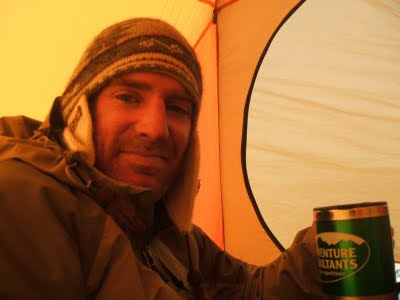
As we rode out the snowstorms while heading up the mountain, it occurred to me that I ought to see if I could generate some free publicity for the artisans of the Colca Valley. Not that I'm making myself out as a model, but a gringo swearing by their product as he tackled the continent's highest mountain might be worth something. In a spare moment at Camp 1, I got my tent mate to shoot a few photos (there's a whole other amusing story about what's going on the background).

After the mountain climbing was over, I headed from Argentina back to Peru for about three weeks. One of my first tasks on arriving in Arequipa was to visit Geovanna, the co-ordinator of the rural community tourism programme in the regional government's tourism office. As well as providing an overview of my thesis, I explained about my endorsement of Colca Valley headwear and gave her copies of the photos.
From there, I spent a couple of weeks in the Colca Valley, trekking, visiting NGO contacts, reporting back on my thesis findings and doing a bit of additional research. On the last Wednesday before I had to go back to Arequipa, I made a day trip from Chivay to Sibayo to catch up with some people and see how the tourism project had advanced since last year. I also wanted to buy some things from the crafts shop to take back to New Zealand. With not a tourist seen since the start of the year, the shop was closed, and it took a while to track down someone to open it up. In the end, I left with a decent haul of chullos and some excellent hand made scarves.
Later I walked the half hour or so across to Callalli and found my way to the Maquicentro. It was closed, and deserted apart from an NGO worker from Arequipa occupying an adjacent office. He was more than happy to find someone to open the Maquicentro, but it took us a few trips around the block before we found someone who had a key (my image from this: the traditionally-dressed señora in sombrero and skirts standing in a muddy corral conversing into a late-model cell phone as she tracked down her comadre). Eventually another señora appeared and opened up the shop for me. She explained about the trials of the wet season looking after the alpacas up in the estancia as I picked out another haul of items to complement the ones I had bought in Sibayo. Among them were another couple of versions of the hat I wore on Aconcagua, which I have officially dubbed the super-chullo.
I returned to Chivay in the usual dilapidated overcrowded minivan with my overflowing backpack squashed between my knees. After a couple more days there, I headed back to Arequipa for my last weekend before returning to New Zealand. On Monday I went to make my final reports and say farewell to Geovanna. She told me she had been in Callalli the previous Friday -- two days after me -- and had given a presentation to the artisans association. In one of her Powerpoint slides she included one of the photos I had given her of the Callalli chullo on Aconcagua. She explained that the photo had been provided by a foreign traveller who had found the hat to be exceptionally warm and comfortable in extreme conditions.
From the audience a woman got to her feet excitedly. "I sold to him!", she announced. (Nice to know she recognised me even though all gringos look alike and I had definitely shaved since that photo was taken).
Geovanna said that the artisans were thrilled with the feedback and it seemed to help drive home to them that they really do have premium products capable of being a hit in international markets. So, even if my academic research is of no practical use to people in the Colca Valley, maybe I've at least provided some useful encouragement.

Forty minutes walk away across the river from Sibayo, the more populous district of Callalli has its own artisans collective that has also received assistance from NGOs and has a wider range of products, extending to sweaters as well as scarves and hats in more mainstream styles that are made on small machines. The micro-industrial character of the craft association's commercial outlet has seen it dubbed the "Maquicentro" (from the Spanish maquina for machine).
Last year, I bought a few things in Sibayo as presents for people back home, including a hand-made scarf that delighted my mother. When visiting Callalli's maquicentro with an NGO from Chivay, I was unable to resist getting myself one of their premium double-layered chullos: warm and beautifully designed with a soft inner lining of baby alpaca.
Although both Sibayo and Callalli have had intermittent success selling to tourists and have even filled some export orders, they struggle to maintain links to markets and obtain the value their products merit. This is partly because their high-quality, hand made crafts get drowned in the sea of cheap mass-produced "alpaca" items sold in thousands of stores and galleries throughout Peru. A shop in the provincial capital of Chivay which the Sibayo municipality subsidized for the craft association proved a disappointment: in addition to its low visibility at the back of a narrow gallery, it was surrounded by numerous other stalls selling hats and gloves, mostly made in Puno factories and any alpaca blended with synthetic fabric, llama and sheep's wool. Casual tourists mostly aren't able to tell the difference.

As reported previously on this blog, this February I climbed Cerro Aconcagua, the highest mountain in the Andes. Included in my extensive gear collection were two warm hats: a fleece North Face beanie, and my Callalli-sourced alpaca chullo. Beyond about base camp, I found the alpaca hat to be much warmer than the fleece beanie, and as we progressed towards the summit I barely took it off. It was also so comfortable and breathed so well that I found I was still wearing it on the way out on the other side of the mountain, as the temperature ticked back up towards 20 degrees Celsis.
As we rode out the snowstorms while heading up the mountain, it occurred to me that I ought to see if I could generate some free publicity for the artisans of the Colca Valley. Not that I'm making myself out as a model, but a gringo swearing by their product as he tackled the continent's highest mountain might be worth something. In a spare moment at Camp 1, I got my tent mate to shoot a few photos (there's a whole other amusing story about what's going on the background).

After the mountain climbing was over, I headed from Argentina back to Peru for about three weeks. One of my first tasks on arriving in Arequipa was to visit Geovanna, the co-ordinator of the rural community tourism programme in the regional government's tourism office. As well as providing an overview of my thesis, I explained about my endorsement of Colca Valley headwear and gave her copies of the photos.
From there, I spent a couple of weeks in the Colca Valley, trekking, visiting NGO contacts, reporting back on my thesis findings and doing a bit of additional research. On the last Wednesday before I had to go back to Arequipa, I made a day trip from Chivay to Sibayo to catch up with some people and see how the tourism project had advanced since last year. I also wanted to buy some things from the crafts shop to take back to New Zealand. With not a tourist seen since the start of the year, the shop was closed, and it took a while to track down someone to open it up. In the end, I left with a decent haul of chullos and some excellent hand made scarves.
Later I walked the half hour or so across to Callalli and found my way to the Maquicentro. It was closed, and deserted apart from an NGO worker from Arequipa occupying an adjacent office. He was more than happy to find someone to open the Maquicentro, but it took us a few trips around the block before we found someone who had a key (my image from this: the traditionally-dressed señora in sombrero and skirts standing in a muddy corral conversing into a late-model cell phone as she tracked down her comadre). Eventually another señora appeared and opened up the shop for me. She explained about the trials of the wet season looking after the alpacas up in the estancia as I picked out another haul of items to complement the ones I had bought in Sibayo. Among them were another couple of versions of the hat I wore on Aconcagua, which I have officially dubbed the super-chullo.

I returned to Chivay in the usual dilapidated overcrowded minivan with my overflowing backpack squashed between my knees. After a couple more days there, I headed back to Arequipa for my last weekend before returning to New Zealand. On Monday I went to make my final reports and say farewell to Geovanna. She told me she had been in Callalli the previous Friday -- two days after me -- and had given a presentation to the artisans association. In one of her Powerpoint slides she included one of the photos I had given her of the Callalli chullo on Aconcagua. She explained that the photo had been provided by a foreign traveller who had found the hat to be exceptionally warm and comfortable in extreme conditions.
From the audience a woman got to her feet excitedly. "I sold to him!", she announced. (Nice to know she recognised me even though all gringos look alike and I had definitely shaved since that photo was taken).
Geovanna said that the artisans were thrilled with the feedback and it seemed to help drive home to them that they really do have premium products capable of being a hit in international markets. So, even if my academic research is of no practical use to people in the Colca Valley, maybe I've at least provided some useful encouragement.
Monday, June 06, 2011
Peru's New Minister of Tourism
Given that it was sent to everyone on his mailing list, I don't think my friend Hugo would mind me reposting this photo with the same title as the subject heading in his email. It gave me a good couple of minutes of chortles.


Exit Polls Showing Humala Win: Reuters Grumpy
Slightly behind in most opinion polls until a couple of days ago, Ollanta Humala appears to be holding a roughly 4 percentage point lead over Keiko Fujimori in exit polls following today's presidential runoff in Peru.
The elections have even made top spot on Stuff's World News page. But let's look at some of the subtle inaccuracies and biases in the Reuters article pasted there.
Humala, 48, has moderated his anti-capitalist views since narrowly losing the 2006 election, and most polls in the run up to the vote had the two candidates in a statistical tie.
Humala was never an anti-capitalist. His 2006 platform had a strong nationalist emphasis, with favourable references to the State-led capitalism of Juan Velasco Alvarado, but I doubt there was ever the slightest mention of Marx.
The elder Fujimori also defeated a Maoist rebel army but fled into exile in 2000 as his government was hit by corruption allegations, and he is now serving a 25-year prison sentence for graft and using death squads against suspected leftists.
Did Fujimori defeat a Maoist rebel army (the Shining Path)? That's what his apologists like to say, but the truth is that it was ingenious police work that tracked down the Lima hiding place of leader Abimael Guzman, after which the Shining Path promptly belied its supposed anti-individualist Maoism and to all intents and purposes, collapsed.
"Corruption allegations" is interesting shorthand for "leaked videos showing incidents of blatant and undeniable corruption for all the world to see".
Still, investors are wary of Humala. Peru's currency and stock market weakened whenever opinion polls showed him gaining ground. The stock market lost $14 billion in the weeks after Humala won the first-round vote, before recovering as Fujimori caught up with him in polls.
If the election is too close to call, there will be a recount, causing even more market volatility.
A paragraph on the stockmarket. Not until late in the article, in a sentence tag-on, is it mentioned that despite the "booming economy", 35 percent of Peruvians still live in poverty.
He promises to respect Peru's many free trade pacts and central bank independence, and to run a balanced budget. But he also favors policies that would increase state control over natural resources in one of the world's top mineral exporters.
For context, it could be mentioned that Peru has the least state control over natural resources of any large Latin American country, particularly compared with "free-market" Chile, where 60 percent a significant proportion of copper production is controlled by the State. An alternative -- and possibly more accurate -- sentence could read: "Humala promises to impose windfall taxes on mining companies that have benefited from unprecedented rises in mineral prices".
Critics say Humala has not abandoned the hard-line ideology instilled in him by his father, a prominent radical. They warn he would take over private firms and change the constitution to allow himself to run for consecutive terms like his one-time political mentor, Venezuelan socialist President Hugo Chavez.
Who are these critics? Do they have any credibility? Should the article not mention that Humala has disavowed these claims?
"Humala's policies are statist and totalitarian," said Rosa Tolentina, a 60-year-old housewife in Lima. "We're going to end up like Venezuela: without freedoms, and poor."
Well yes, it's understandable that a housewife would say something like this, given what the corporate media have been saying. But again, is this credible? Is this an appropriate, balanced way to finish the article?
Wednesday, June 01, 2011
Important Stuff Out There
Just links today, but on some matters that I think are pretty important:
Gordon Campbell has a typically excellent post on the Government's decision to consider implementation of the Welfare Working Group's recommendations.
Terence Wood describes NZAID's rapid move away from international best practice under Murray McCully.
The Auckland Transport Blog assesses the Government-commissioned Ministry of Transport review of Auckland's proposed inner-city rail loop, and the Auckland Council's commissioned review of its own business case.
David Haywood proposes the "Copenhagenization" of Christchurch, in the sense of making it live up to its bicycle-friendly potential in the post-reconstruction period.
Monday, May 02, 2011
Humala the Neostructuralist?
An excerpt from an interview given by presidential candidate Ollanta Humala on Peruvian TV last week (my translation):
Humala: First, when we talk, really about the model...we're not proposing to go outside the capitalist economic model.
Interviewer: But, the impression of many who've spoken from your camp...it would seem so.
Humala: Sure, that's why the commitment I'm making to the nation is that we're going to provide an open economy, based on the market, which is the national market economy, but which looks to create and promote other productive forces. And why is that? Because the Peruvian economy, fundamentally, depends on the rent from mining. And the mining rent is high these days because of high international mineral prices. That doesn't depend on Peru, it depends on the current international context. And if those prices fall, so does the Peruvian economy. So, we can't now be so irresponsible as to believe that international prices are going to stay high for 10 or 20 years, that's not sustainable over time. This is the moment, now there's money, to stabilize and consolidate economic growth through other productive activities such as tourism, such as agriculture, agro-industry, agro-exportation, (pastoral) farming, national industries. And that implies good quality education, to generate value-adding industries.
The most remarkable thing about these statements is how unremarkable they are. Humala's answers could come directly from an introductory development studies text, noting the drawbacks of relying on primary resource exports and stressing the need to develop a diversified, more sustainable economy with greater local participation. The role envisaged for the State in steering the economy towards greater competitiveness, especially through improved education, is in line with a broad church of thinking termed “neostructuralism” which in the Latin American context has its clearest exposition in Osvaldo Sunkel's volume Development from Within . The first-up mention of tourism as an important alternative economic activity is interestingly in tune with the arguments in chapters 3 and 4 of my thesis (forthcoming).
In short, this is pretty mainstream stuff. If we take him at his word, Humala plans to make some policy reorientations that would bring Peru more in line with just about every other South American country, with the possible exception of Colombia. Yet, you would hardly know it by the fear and loathing with which the possibility of a Humala victory in the presidential run off is being received by many in the Peruvian upper middle classes and some sections of the media. More on that in a further post.
Saturday, April 30, 2011
Aconcagua: Gear Issues
More on Aconcagua, this time about gear. This post covers a few of the surprising and obscure gear-related things I discovered on the expedition. In another post I'll go more systematically through the various gear categories.

Get to grips with your balaclava
Some of the trickiest items of gear to get right are the ones you never need until you're in really extreme conditions. For example, the balaclava. This is something you might not pay much attention to. Everyone's used to jackets, sleeping bags, boots, and it's easy to imagine them needing to be bigger and warmer high up on the mountain. But needing to cover your whole face is a little harder to envisage until you're actually being battered by freezing winds and horizontal snow. At this point, you really want your balaclava to fit well, and to let you breathe.
A couple of days before our summit attempt. I was pretty sure I would need to wear a balaclava for good part of the ascent, especially on the stretch from Independencia to the Cave where the wind is usually relentless. I hadn't got used to wearing either of mine in a way that I felt comfortable with and was panicking slightly. On the climb to camp 3 in fine conditions I experimented with wearing my buff over my nose and mouth. I found that to be ok when walking slowly and steadily, but rapidly ran out of breath whenever I had to make an effort. How would I manage on the summit climb? Would I be forced to choose between running out of oxygen or getting a frostbitten nose?
Fortunately, we were blessed with a summit day of unusual calm; on the infamous traverse (see picture) there was hardly a breeze. I wore my balaclava in the morning cold up to the rest stop at Independencia (6,400 metres) and then dispensed with it. But when we are eating dinner on our arrival back at Penitentes, we sat next to a group of Polish climbers who had summited on a different day than us: several of them had painful-looking swathes of windburn across their faces, rather like protagonists of that joke where you answer the phone while ironing.
Kill two birds with one pair of sandals
There's little doubt that on Aconcagua you'll need two main pairs of footwear: regular trekking boots for the walk in and double plastic boots from base camp. The gear list from Adventure Consultants also recommended: 1) some old running shoes for wearing around camp and using in river crossings and 2) down booties for wearing around camp and in your tent/sleeping bag. Based on my experiences, I would scratch both those items and replace them with a good lightweight pair of sandals. The running shoes were comfortable to wear around camp on the walk in, and I did use them on our one (brief but stunningly cold) river crossing. However, from base camp space and weight were at a premium and there was no way I could justify taking the shoes. I did squeeze in the down booties, but found they weren't up to the task of tramping round camp in the deep snow. Their role inside the tent is limited, since you mostly just put your feet in your sleeping bag to keep them warm.
After many occasions battling to get my double plastic boots on and off just to get in and out of the tent, I was looking enviously at the sandals worn by a couple of other expedition members. Small and light enough to carry, they can be worn with socks (there are no fashion crimes above 5,000 metres) and are a good option for short trips around camp. Sure, they're not the best in deep snow either, but are more robust and more easily cleaned or dried than the booties.
Yes, you need those water bottle jackets
Another obscure item you might not spent much thought on is the insulating "jacket" for your water bottles. While I researched and fretted about many of the items on the gear list, I had completely forgotten about these, and was fortunate enough that my sister Terri threw a couple in with some other things I borrowed off her just before I left. They aren't always sufficient to stop your water from freezing, but they are necessary.
Also, one area where I felt the pre-trip advice was wide of the mark was the recommendation to take two 1-litre drink bottles (plus one pee bottle). Most days you want to drink at least 3 to 4 litres, and for much of the expedition there's no chance to refill. We had to use coke or mineral water bottles for the additional water, which was not ideal. I would recommend taking at least 3 dedicated, wide-mouth 1-litre water bottles on the expedition. The softer plastic Nalgene bottles are probably better than the hard plastic ones, since they squash down better when empty.
Hand warmers are worth it
When I looked at the suggestion of hand warmers on the gear list I was a little sceptical. Surely if you got the right gloves and mittens you wouldn't need them? Well, yes. Top-line mittens will be plenty warm enough if you have them on the whole time. But to do anything like opening your pack, getting water, or even adjusting your hood, you need to strip to liner gloves or even, as in my case for about 15 minutes on summit morning, your bare hands. Your mittens might not be enough to warm your hands back up, and a throwing a couple of toasty hand warmers in them gives you extra security. On the other hand, there's not much point in getting specialist toe warmers: there's generally no space for them in a well-fitting pair of boots.
Try it all on
As I gradually accumulated gear in the months before the expedition I on various occasions got myself dressed up in layers of thermals, jackets, pants and socks. I felt rather stupid as I tried out my down jacket in the middle of summer, sweat pouring off as I fiddled with various chords and zips. Ultimately, however, I probably didn't do enough of this. You really should know exactly how everything zips, buckles and fastens, what can be worn with what, the best way to adjust your hoods, and so on. And you should practice doing it all with gloves on. For the same reason, as much of the gear as possible should be your own. Most items can be hired in Mendoza, but renting an item from a limited selection with 15 minutes to choose is not ideal. I got pretty much everything except crampons and ice pick. I did generally get to grips with the crampons in my hotel room in Mendoza, but on summit day I realised that I'd never tried them on with my snow gaiters and insulated pants. The extra bulk under the already short straps meant I had a panicky 5 minutes or so wrestling to get the crampons tightened in -15 degree conditions on summit morning.
Sunday, April 17, 2011
Important Things About Aconcagua
I still plan to write a blow by blow account of the Aconcagua trip: it was about sixteen days up and down, so it's going to be spread over at least three posts. Meanwhile, here are some general thoughts about things I learned or found to be very important during the expedition. Some of them might be useful advice for people thinking of making the Aconcagua trip themselves. In another post I'll focus specifically on gear issues.
It's the Guides, Stupid
Some very experienced mountaineers will prefer to organise the trip themselves, taking care of all the gear and food, planning their route, and evaluating the weather. For the rest of us who go on an organized expedition, the quality of the guides is paramount. I cannot exaggerate the importance of the contribution made by our three guides: Matias (Chilean, lead guide, 16 previous Aconcagua summits), Leo, (from Mendoza, 11 previous summits) and Agustin (also from Mendoza, 7 previous summits). The expedition was organised by Adventure Consultants, based in Wanaka, New Zealand, and the local agent was Fernando Grajales Expeditions of Mendoza. Both companies did an exemplary job with the logistics. But up on the mountainside, any plans and policies of the tour operators rely on the guides to implement them properly.
The first night we all met up at the hotel in Mendoza, Matias gave a briefing which set the tone for the expedition. He told us that the objectives were, in order: 1) to get off the mountains safely; 2) to enjoy the "process" of climbing and learn something; and 3) to reach the summit. In a period where three people died on the mountain and a number more were evacuated with frostbite, none of us were left in any doubt about the wisdom of that approach.
Eat,Pray, Love, Drink, Eat
If I were asked to identify the other most important success factor for Aconcagua, it wouldn't be great physical fitness. Sure, there are some minimum standards. But apart from a couple of hours here and there on different days, it's wasn't an especially athletic expedition. The slow, steady rhythm set by the guides was aimed at conserving energy. If you work out a lot or play sport, you'll probably actually lose form while on the mountain.
No, the key to survival and success on the mountain was simply to eat and drink as much as possible. To operate at altitude, as a friend in Peru once said, you need a "strong organism", and that organism has to be constantly refuelled. On Aconcagua, everything dehydrates you: on the walk in, it's the heat; higher up, it's the altitude. So, if you want to do well, you have to drink a lot of water. Drink before you get thirsty. Drink more than you think you need. Wake up in the middle of the night and drink some more.
Eating is just as important. All the theory says that you lose appetite at altitude, and most of the accounts I read of people's experiences on Aconcagua described forcing down minimal quantities of food at the higher camps. This wasn't so for me and most of the others who made it to the summit. In fact, the guides said they were rather taken aback by how much I and my tent mate were still eating at 6,000 metres, "maybe even more than at sea level". This was helped by the fact that the quality of the food was very good, which again, was in large part thanks to the guides. One of the defining moments of the expeditions came after we had braved a fierce snow storm to arrive at camp 2 and set up our tents. Cold, bedraggled and anxious about our prospects of even getting an attempt at the summit, I and my tent mate were roused by the voice of Agustin telling us that dinner was ready. We unzipped the back door to find Agustin, icicles clinging to his beard, holding a large pot from which he served us generous helpings of spicy meat and and rice. It was one of the most memorably delicious meals I've had, and greatly improved our mood at a difficult time.
Details Matter
I hoped the Aconcagua expedition would be a learning and growing experience for me, and in a number of ways it was, even if it just showed me how far I still had to go. One of the sharpest learning curves was to do with organisation and attention to detail. So many small things can derail your expedition. Secure your tent ineffectively or leave it unzipped and it could blow away, ending your trip. Fail to dry your boot liners or let your water bottle freeze and you could be in big trouble. It's not just with gear that that things can go wrong, but with your own person. Catch a cold or get a bout of diarrhea up high, and your body may not be able to recover quickly enough. Sunburn, headaches, blisters, and dehydration can all be dangerous as well.
So, you need to be meticulous about keeping your hands clean, your feet dry, your body warm, your skin protected, and your things stashed and organised. There are many details to think about. Are your plate, cup and spoon quickly accessible? Can your jacket be easily pulled out and stashed again at rest stops? Are your trekking poles set to the right length for the terrain (shorter for up hill, much longer for down)? How can you secure your water bottle to allow you to take sips while you walk?
It's also important to be familiar with all your clothes and equipment before the expedition, including how things tie, zip and buckle, what can be worn with what, and so forth. More about this in the post on gear. Despite my efforts to improve my organisational skills, and many nights spent lying in my sleeping bag mentally organising my pack, I struggled with this aspect and was always one of the last to be ready, starting in the morning, pitching and packing tents, and at rest stops (to be fair, three of my companions were ex-military).
Stay Regular
There was a lot of pre-trip information from Adventure Consultants, ranging from the essential to the relatively obscure, from advice on insurance to tips on high-altitude photopgraphy. Funnily, nowhere was there any comment about something that had inspired curiosity in most expedition members: how would we go to the toilet? Up to and including base camp, there's little mystery. Each expedition company supplies the camps with long drops -- barrels which are helicoptered out when full.
Beyond base camp, it's a different story. Within Aconcagua Provincial Park, the authorities have taken the admirable decision that you can't just "go" anywhere. Each person is given a quota of "wag bags" which they must use for any number two beyond 4,200 metres. The wag bag includes an inner, larger bag which contains a chemical powder that neutralizes and deodorizes excrement, as well as an outer ziplock bag designed to hold the inner bag.
For me, learning to love the bag was an important mental step in surviving and thriving on Aconcagua. It's tricky enough to aim into a bag in any situation, but when perched on a mountainside at -15 Celsius with snow and freezing winds, it becomes an adventure sport. Yet, it's not a good idea to avoid a showdown by eating less or just bottling it up. Staying healthy and comfortable means staying regular, so you need to treat it as just one more challenge to embrace.
It's the Guides, Stupid
Some very experienced mountaineers will prefer to organise the trip themselves, taking care of all the gear and food, planning their route, and evaluating the weather. For the rest of us who go on an organized expedition, the quality of the guides is paramount. I cannot exaggerate the importance of the contribution made by our three guides: Matias (Chilean, lead guide, 16 previous Aconcagua summits), Leo, (from Mendoza, 11 previous summits) and Agustin (also from Mendoza, 7 previous summits). The expedition was organised by Adventure Consultants, based in Wanaka, New Zealand, and the local agent was Fernando Grajales Expeditions of Mendoza. Both companies did an exemplary job with the logistics. But up on the mountainside, any plans and policies of the tour operators rely on the guides to implement them properly.
The first night we all met up at the hotel in Mendoza, Matias gave a briefing which set the tone for the expedition. He told us that the objectives were, in order: 1) to get off the mountains safely; 2) to enjoy the "process" of climbing and learn something; and 3) to reach the summit. In a period where three people died on the mountain and a number more were evacuated with frostbite, none of us were left in any doubt about the wisdom of that approach.
Eat,
If I were asked to identify the other most important success factor for Aconcagua, it wouldn't be great physical fitness. Sure, there are some minimum standards. But apart from a couple of hours here and there on different days, it's wasn't an especially athletic expedition. The slow, steady rhythm set by the guides was aimed at conserving energy. If you work out a lot or play sport, you'll probably actually lose form while on the mountain.
No, the key to survival and success on the mountain was simply to eat and drink as much as possible. To operate at altitude, as a friend in Peru once said, you need a "strong organism", and that organism has to be constantly refuelled. On Aconcagua, everything dehydrates you: on the walk in, it's the heat; higher up, it's the altitude. So, if you want to do well, you have to drink a lot of water. Drink before you get thirsty. Drink more than you think you need. Wake up in the middle of the night and drink some more.
Eating is just as important. All the theory says that you lose appetite at altitude, and most of the accounts I read of people's experiences on Aconcagua described forcing down minimal quantities of food at the higher camps. This wasn't so for me and most of the others who made it to the summit. In fact, the guides said they were rather taken aback by how much I and my tent mate were still eating at 6,000 metres, "maybe even more than at sea level". This was helped by the fact that the quality of the food was very good, which again, was in large part thanks to the guides. One of the defining moments of the expeditions came after we had braved a fierce snow storm to arrive at camp 2 and set up our tents. Cold, bedraggled and anxious about our prospects of even getting an attempt at the summit, I and my tent mate were roused by the voice of Agustin telling us that dinner was ready. We unzipped the back door to find Agustin, icicles clinging to his beard, holding a large pot from which he served us generous helpings of spicy meat and and rice. It was one of the most memorably delicious meals I've had, and greatly improved our mood at a difficult time.
Details Matter
I hoped the Aconcagua expedition would be a learning and growing experience for me, and in a number of ways it was, even if it just showed me how far I still had to go. One of the sharpest learning curves was to do with organisation and attention to detail. So many small things can derail your expedition. Secure your tent ineffectively or leave it unzipped and it could blow away, ending your trip. Fail to dry your boot liners or let your water bottle freeze and you could be in big trouble. It's not just with gear that that things can go wrong, but with your own person. Catch a cold or get a bout of diarrhea up high, and your body may not be able to recover quickly enough. Sunburn, headaches, blisters, and dehydration can all be dangerous as well.
So, you need to be meticulous about keeping your hands clean, your feet dry, your body warm, your skin protected, and your things stashed and organised. There are many details to think about. Are your plate, cup and spoon quickly accessible? Can your jacket be easily pulled out and stashed again at rest stops? Are your trekking poles set to the right length for the terrain (shorter for up hill, much longer for down)? How can you secure your water bottle to allow you to take sips while you walk?
It's also important to be familiar with all your clothes and equipment before the expedition, including how things tie, zip and buckle, what can be worn with what, and so forth. More about this in the post on gear. Despite my efforts to improve my organisational skills, and many nights spent lying in my sleeping bag mentally organising my pack, I struggled with this aspect and was always one of the last to be ready, starting in the morning, pitching and packing tents, and at rest stops (to be fair, three of my companions were ex-military).
Stay Regular
There was a lot of pre-trip information from Adventure Consultants, ranging from the essential to the relatively obscure, from advice on insurance to tips on high-altitude photopgraphy. Funnily, nowhere was there any comment about something that had inspired curiosity in most expedition members: how would we go to the toilet? Up to and including base camp, there's little mystery. Each expedition company supplies the camps with long drops -- barrels which are helicoptered out when full.
Beyond base camp, it's a different story. Within Aconcagua Provincial Park, the authorities have taken the admirable decision that you can't just "go" anywhere. Each person is given a quota of "wag bags" which they must use for any number two beyond 4,200 metres. The wag bag includes an inner, larger bag which contains a chemical powder that neutralizes and deodorizes excrement, as well as an outer ziplock bag designed to hold the inner bag.
For me, learning to love the bag was an important mental step in surviving and thriving on Aconcagua. It's tricky enough to aim into a bag in any situation, but when perched on a mountainside at -15 Celsius with snow and freezing winds, it becomes an adventure sport. Yet, it's not a good idea to avoid a showdown by eating less or just bottling it up. Staying healthy and comfortable means staying regular, so you need to treat it as just one more challenge to embrace.
Monday, April 11, 2011
Peruvian Elections: Humala First, Second Round Unpredictable
For various reasons (Master's thesis, Aconcagua, travelling in Peru away from internet access, many things to do on arrival back to New Zealand), I haven't done any blog posts on the Peruvian presidential and congressional elections, which took place on Sunday 10 April local time. The line up of candidates made as much, if not more of a soap opera story as it did in 2006. The lead up had even more twists and turns, as right until the end there were five candidates with possibilities of making it through to the second round of voting.
In the end, the result of the first round has meant a rather different scenario than the last elections. As he did in 2006, Nationalist candidate Ollanta Humala headed the initial vote. Coming from seeming irrelevance only a couple of months ago when he was polling below 10 percent, Humala won around 32 percent of the vote, almost identical to his numbers five years ago.
However, this time there's not going to be a solid alliance of the "democratic" establishment against "authoritarian" Humala of the sort which benefited Alan Garcia in 2006. This is because Humala's opponent in the second round will be Keiko Fujimori, the daughter of the currently imprisoned ex-dictator, who in her campaign has frequently referred back to what "we" did in the 1990s. As La Republica columnist Mirko Lauer puts it:
In addition, if it's about a competition between two political chambers of horrors, the phrase used by political scientist Steven Levitsky is eloquent: "you can have doubts about Ollanta but about Keiko we've got proof"
The success of Humala and Fujimori sends a clear message. The establishment candidates -- 2001--2006 president Alejandro Toledo, former Lima mayor Luis Castañeda and one-time Prime Minister Pedro Pablo Kuzcysnzki (PPK) -- eventually obtained less than 45 percent of the vote between them. It's not quite true, as is being portrayed in some places, that Peruvians abandoned the centre and chose contrasting "extremes". Despite being placed on the far right, Fujimori shares a similar economic approach with the other three candidates -- with PPK probably the purest neoliberal -- while Humala is hardly "leftist" in any coherent sense. What these two have in common is their populism, and the perception that in some sense they are outsiders. Their strong showing amounts to a rejection of continuismo and disagreement with the establishment argument that staying with Peru's current economic and political track will eventually be good for everyone.
Since the last election, Humala has gone a considerable way towards moderating his image. He's been dressing smarter, got a team of Brazilian advisors to give his policies an aura of Lula-ness, and avoided the association with Hugo Chavez that Alan Garcia took such advantage of last time. Already, the sort of people who pegged their noses and reluctantly voted for Garcia are wondering whether he might be the least worst option. Mario Vargas Llosa, for example, has said that he "could" vote for Humala, depending on the kind of alliances he forms, but could never vote for Fujmori. In another post, I'll give my own opinion.
Subscribe to:
Posts (Atom)