Since the last post on training for the half marathon, I've managed four training runs of 16 to 17 km. I managed to reduce my 17km-ish time from around 1 hr 11 to a little over 1 hr 09, and on the 14km section which tracks the actual course of the race I improved from 58 minutes to a little over 56.
However, to be fair, the last couple of runs have been in close to perfect conditions whereas the first one was in a howling northerly of extrordinary strength -- heading north back around Point Jeringham the gusts were so strong that at one stage I was actually making no progress despite pushing into the wind with all my force. So it's questionable how much improvement I've actually made.
The last week has been a bit of a write off for training purposes. I spent the weekend doing the Southern Crossing of the Tararuas, and then I allowed recovery time to be in reasonable shape for my two mid-week games of indoor football (they're close to the highlight of my week and take precedence over everything else). There's also been some non-optimum eating and drinking over the past few days.
I have one more training run tomorrow, and then that's it until race day next Sunday.
This brings me back to the issue of wind and wind direction. Presumably because it's an add-on to the 7km Round the Bays fun run, this half marathon is not geographically balanced, unlike the Harbour Capital race run in June, which is an "out and back" course. The course heads from Frank Kitts Park to Cobham Drive, up around the Miramar peninsula almost to Scorching Bay, then back to Kilbirnie Park. Two-thirds of the course goes essentially north to south, making a significant net movement south over the race as a whole.
This means that, while light winds would still be preferable, a moderately fresh northerly would still be ok, because it would be close to a tail wind for two thirds of the race, including the last leg. Even a light southerly would be ok: I've found I can still do the first 7km leg into the breeze in 28--29 minutes, and a tail wind would be useful in the 'difficult' middle part of the race. Where things would really come unstuck is in a fresh southerly, so I'm praying we don't get those conditions next Sunday.
The race starts at 8:30 am, so strong sun and warm temperatures should also be taken out of the equation (yes, we actually have had a little bit of those recently in Wellington). The ideal would be a light northerly, overcast, around 16 degrees and maybe the lightest of intermittent drizzle. Currently the forecast says fine with a high of 20 and a northerly at 30 km/h. That would be acceptable! But weather forecasts can of course change in a week.
It's been good to have a goal, but pounding up and down the pavements is not actually my favourite activity, and it does take a lot out of you. Succeed or fail in the half marathon, I'll be quite glad to get back to regular trips to the gym and of course the football.
Saturday, January 23, 2010


Scooter Races
I had to put up these pictures, from Christmas Day at my parents' place in Rolleston. My almost-five year old niece Alex and almost-three year old nephew Tommy got scooters for Christmas. Tommy hasn't quite got the scootering thing figured yet, although judging by his trampolining and tricycling skills (including braking), it won't be far away.
Alex on the other hand hardly wanted to leave the scooter for a second, and was keen to take on all comers, including her uncle.
Needless to say, I was no match for a light and nimble almost-five year old. "You're too sloow", was the verdict from the finish line as I scrambled the last few metres down the driveway.
To be fair, I was hindered a little by not putting my whole weight onto the scooter, keen not to buckle the kids' Christmas present. Later, on a longer run down a footpath in Kaipoi, Alex's Dad Jeremy showed this was indeed possible and I was able to gather a bit more speed -- but not enough to catch up with Alex.


Alex on the other hand hardly wanted to leave the scooter for a second, and was keen to take on all comers, including her uncle.
Needless to say, I was no match for a light and nimble almost-five year old. "You're too sloow", was the verdict from the finish line as I scrambled the last few metres down the driveway.
To be fair, I was hindered a little by not putting my whole weight onto the scooter, keen not to buckle the kids' Christmas present. Later, on a longer run down a footpath in Kaipoi, Alex's Dad Jeremy showed this was indeed possible and I was able to gather a bit more speed -- but not enough to catch up with Alex.


Thursday, January 14, 2010
Latin America's Gifts to the World
Many thanks for the responses to my previous post from my regular readers (all three of you). Between you, you managed to name most of the major food products or ingredients that come from the Americas and were unknown elsewhere in the world until the 16th century. There's still a few more than didn't get named, but sufficient time has passed and it doesn't look like I'm going to get any more responses.
Here is the list I had in mind, after much consultation of Wikipedia. I may have missed a few myself, so feel free to point out any other products I might not have thought of.
Potatoes
Maize / corn
Chili
Chocolate / cocoa
Vanilla
Common bean (green, red, black, yellow, pinto, etc)
Tomatos
Avocados
Squash family (including courgette, marrow, pumpkin)
Peanuts
Cashew nuts
Brazil nuts
Pineapple
Papaya
Guava
Coca (as in Coca Cola, so yes it qualifies as a food ingredient or flavouring, as well as a narcotic).
Related to the last item, apparently Latin America is also home to about 85 percent of all known hallucinogenic plants. As far as I know no one has a really good theory about why that is.
The American origin of many of the above comes as quite a surprise (or at least it does to me), given how inherently globalised they seem. It's therefore interesting to reflect that none of the following are native to Latin America and were unknown there until the 16th century:
Sugar
Coffee
Bananas
Here is the list I had in mind, after much consultation of Wikipedia. I may have missed a few myself, so feel free to point out any other products I might not have thought of.
Potatoes
Maize / corn
Chili
Chocolate / cocoa
Vanilla
Common bean (green, red, black, yellow, pinto, etc)
Tomatos
Avocados
Squash family (including courgette, marrow, pumpkin)
Peanuts
Cashew nuts
Brazil nuts
Pineapple
Papaya
Guava
Coca (as in Coca Cola, so yes it qualifies as a food ingredient or flavouring, as well as a narcotic).
Related to the last item, apparently Latin America is also home to about 85 percent of all known hallucinogenic plants. As far as I know no one has a really good theory about why that is.
The American origin of many of the above comes as quite a surprise (or at least it does to me), given how inherently globalised they seem. It's therefore interesting to reflect that none of the following are native to Latin America and were unknown there until the 16th century:
Sugar
Coffee
Bananas
Saturday, January 09, 2010
The Joy of Chili
Today's interesting Wikipedia article: a summary of the biology, history and culinary uses of the chili pepper in all its varieties and permutations. I have to admit to being surprised that the plant family is native only to South and Central America (including the Caribbean). Who would have thought that with its importance to cuisine from East Africa to Italy to India to Southeast Asia to China, this marvellous source of piquancy only become known to the rest of the world through Iberian colonisation of the Americas in the 16th century?
If they haven't already, someone should surely write a sweeping historical biography of the pepper's rise to world domination, along the lines of such books on salt, sugar, and, um, cod.
A prize to readers who can name other major food products that are widespread staples or central ingredients in national and international cuisines yet are relatively recent gifts to the world from Latin America. (Actually, no prize sorry, but see if you can name some anyway).
If they haven't already, someone should surely write a sweeping historical biography of the pepper's rise to world domination, along the lines of such books on salt, sugar, and, um, cod.
A prize to readers who can name other major food products that are widespread staples or central ingredients in national and international cuisines yet are relatively recent gifts to the world from Latin America. (Actually, no prize sorry, but see if you can name some anyway).
Wednesday, January 06, 2010
Mountain Climbing Preparations, No 1 -- Training by Running
Having a big, long-term, terrifying goal has flow-on effects. It motivates you to to do things which then develop their own sub goals.
One of the ways to train for mountain climbing (or anything that requires endurance) is running. The training web sites recommend that as much as possible you train "in kind", i.e. by actually carrying a heavy pack uphill. However, there's limits to how much or how often you can do this (viz, aborted tramping trip in the Tararuas, Dec 17--20). And in any case, it may not be possible to simulate the stresses you will be under climbing. The duration, pace, elevation and difficulty of any treks you get to do will depend on things like the time available, the terrain accessible, the preferences of your trekking companions, and the vagaries of the weather.
Running, on the other hand, allows you to destroy yourself at your leisure. And with my ability at cycling (distinctly mediocre) or swimming (close to non-existent), running is the obvious choice for sustainable, easy-access pain infliction.
Thus, it was the decision to aim for Aconcagua that provided the incentive to get back into running. I was long past due to replace my running shoes, since my existing ones were falling apart and never fit me that well anyway. When I finally made the trip down to the Shoe Clinic to have my gait analysed and buy some shoes, I'm not sure if I'd actually gone as far as saying it out loud, but the idea was certainly germinating somewhere in my mind.
At first I mainly ran on hills, or at least included a hill in the run. I managed to run for 1 hr 45 around the bays, with a loop up part of Mt Victoria. I did several runs up to the Brooklyn wind turbine. From my flat in Northland, that requires a descent to Aro St, followed by perhaps 280 metres of vertical ascent over a few kilometres.
In the most recent of these excursions, I pushed on past the windmill along the increasingly rough track that heads towards a mysterious radar station and eventually the sea. After about 25 minutes on this track, it started to get dark, the misty drizzle got thicker, and in the end I only just turned around in time to make it back to the windmill before the weather and the night closed in. I had been out nearly two hours -- not long by marathoners' standards, but seemingly a bridge too far for my body. I must have suffered dehydration, salt loss, or something, aggravated by being battered around in two indoor football games over the next couple of days (see future post on "training mix"). For about the next week I felt wiped out, even mildly depressed.
I was at risk of getting discouraged and allowing my training schedule to drift into haphazardness. Fortunately, I discovered that there is a half marathon scheduled for February 21 as part of the Wellington Round the Bays event. The opportunity to run under 1 hr 30 is something of a lifetime goal and a definite motivation. I have run three previous half marathons, in times of 1:34, 1:37 and 1:31. The last two were in strong northerly winds, and the last one may have been "worth" less than 1 hr 30, given that the winner didn't go far under 1:10 and I was 80th in a field of 800. But the time you did is the time you did, and it remains the case that I've never broken that magical figure.
I've now entered the race, and even just the anticipation of entering was enough to inspire a 16 1/2 km post-Christmas jog when I was down south at my parents' place. Since coming back to Wellington, I ran over the course last Thursday (appreciating the rata-splashed joys of the Miramar peninsula), and on Sunday did an out-and-back run of the first leg from Frank Kitts Park to Kilbirnie Park. I managed the course proper in 1 hr 35, while the 14km Sunday run took bang on an hour. That leaves substantial room for improvement if I want to reach my target.
Slightly worrying is that on both occasions there was a northerly tail wind on the first leg and I couldn't do it in less than 29 minutes: on Thursday my 7km splits were 31/34/30, and on Sunday approximately 29/31. It was somewhat odd that Sunday's last leg should be the quickest: on the positive side it shows good endurance, but on the negative, it could suggest that for some reason (encroaching age, poor technique?) I have no speed.
A consoling factor is that I think (based on my reading of the course map) that I have been adding some extra distance on to the first bit by doglegging around Te Papa. I have also been running with a small backpack carrying a little food, light pants and a sweater, and carrying a drink bottle in one hand. You don't want to run for an hour or more without liquid, but I think the bottle may be a slowing factor by restricting use of the arm which is carrying it. On Sunday, I ditched the bottle in a bin by Cobham Drive; it was notable that my time on the return leg was only 2 minutes slower despite running into a howling northwesterly that was so strong at times it was hard to stay upright.
Anyway, I'm off for another run tomorrow, and this time will be able to leave my things at work and run without a backpack, so we'll see how that goes. Also, although I know it's good practice, it would be nice to have a little bit less wind!
One of the ways to train for mountain climbing (or anything that requires endurance) is running. The training web sites recommend that as much as possible you train "in kind", i.e. by actually carrying a heavy pack uphill. However, there's limits to how much or how often you can do this (viz, aborted tramping trip in the Tararuas, Dec 17--20). And in any case, it may not be possible to simulate the stresses you will be under climbing. The duration, pace, elevation and difficulty of any treks you get to do will depend on things like the time available, the terrain accessible, the preferences of your trekking companions, and the vagaries of the weather.
Running, on the other hand, allows you to destroy yourself at your leisure. And with my ability at cycling (distinctly mediocre) or swimming (close to non-existent), running is the obvious choice for sustainable, easy-access pain infliction.
Thus, it was the decision to aim for Aconcagua that provided the incentive to get back into running. I was long past due to replace my running shoes, since my existing ones were falling apart and never fit me that well anyway. When I finally made the trip down to the Shoe Clinic to have my gait analysed and buy some shoes, I'm not sure if I'd actually gone as far as saying it out loud, but the idea was certainly germinating somewhere in my mind.
At first I mainly ran on hills, or at least included a hill in the run. I managed to run for 1 hr 45 around the bays, with a loop up part of Mt Victoria. I did several runs up to the Brooklyn wind turbine. From my flat in Northland, that requires a descent to Aro St, followed by perhaps 280 metres of vertical ascent over a few kilometres.
In the most recent of these excursions, I pushed on past the windmill along the increasingly rough track that heads towards a mysterious radar station and eventually the sea. After about 25 minutes on this track, it started to get dark, the misty drizzle got thicker, and in the end I only just turned around in time to make it back to the windmill before the weather and the night closed in. I had been out nearly two hours -- not long by marathoners' standards, but seemingly a bridge too far for my body. I must have suffered dehydration, salt loss, or something, aggravated by being battered around in two indoor football games over the next couple of days (see future post on "training mix"). For about the next week I felt wiped out, even mildly depressed.
I was at risk of getting discouraged and allowing my training schedule to drift into haphazardness. Fortunately, I discovered that there is a half marathon scheduled for February 21 as part of the Wellington Round the Bays event. The opportunity to run under 1 hr 30 is something of a lifetime goal and a definite motivation. I have run three previous half marathons, in times of 1:34, 1:37 and 1:31. The last two were in strong northerly winds, and the last one may have been "worth" less than 1 hr 30, given that the winner didn't go far under 1:10 and I was 80th in a field of 800. But the time you did is the time you did, and it remains the case that I've never broken that magical figure.
I've now entered the race, and even just the anticipation of entering was enough to inspire a 16 1/2 km post-Christmas jog when I was down south at my parents' place. Since coming back to Wellington, I ran over the course last Thursday (appreciating the rata-splashed joys of the Miramar peninsula), and on Sunday did an out-and-back run of the first leg from Frank Kitts Park to Kilbirnie Park. I managed the course proper in 1 hr 35, while the 14km Sunday run took bang on an hour. That leaves substantial room for improvement if I want to reach my target.
Slightly worrying is that on both occasions there was a northerly tail wind on the first leg and I couldn't do it in less than 29 minutes: on Thursday my 7km splits were 31/34/30, and on Sunday approximately 29/31. It was somewhat odd that Sunday's last leg should be the quickest: on the positive side it shows good endurance, but on the negative, it could suggest that for some reason (encroaching age, poor technique?) I have no speed.
A consoling factor is that I think (based on my reading of the course map) that I have been adding some extra distance on to the first bit by doglegging around Te Papa. I have also been running with a small backpack carrying a little food, light pants and a sweater, and carrying a drink bottle in one hand. You don't want to run for an hour or more without liquid, but I think the bottle may be a slowing factor by restricting use of the arm which is carrying it. On Sunday, I ditched the bottle in a bin by Cobham Drive; it was notable that my time on the return leg was only 2 minutes slower despite running into a howling northwesterly that was so strong at times it was hard to stay upright.
Anyway, I'm off for another run tomorrow, and this time will be able to leave my things at work and run without a backpack, so we'll see how that goes. Also, although I know it's good practice, it would be nice to have a little bit less wind!
Friday, January 01, 2010
Non-Traditional Exports in the Andes
I'm a regular reader of Peruvian economist and La Republica columnist Humberto Campodónico -- for New Zealand readers, sort of a cross between Brian Easton and Rod Oram. Campodónico writes dense, detailed columns on the world and Peruvian economies, with particular attention to national policies on natural resources such as minerals, petroleum and gas. He is a trenchant critic of what he argues is the Peruvian government's unreformed neoliberalism, its lack of a coherent plan for development and its pandering to the whims of international investors in extractive industries.
Campodónico often resembles a traditional investigative journalist, as he strings together data and timelines to demonstrate how resources have been given away cheaply or tax revenue needlessly wasted. It's hard to imagine a columnist with such a wonkish, fact-based approach, which requires readers to really concentrate, getting such a prominent slot in a New Zealand newspaper.
A particularly interesting recent column compares the progress in developing "non-traditional exports" in Peru, Chile and Colombia. In Latin America, "traditional" exports refer to primary materials such as minerals and petroleum and unprocessed cash crops such as bananas and sugar. These have often been dominated by international coporations operating in economic "enclaves". "Non-traditional" exports are those with a greater value-added content: often, though not always, they are produced at a smaller scale, are more labour-intensive and tend to be locally owned.
A rise in non-traditional exports can be viewed as one measure of the strength of a developing country's economy. Exports are of course important because they provide the foreign currency needed to buy things that aren't produced locally and to pay for borrowing. A higher proportion of "non-traditional" products may indicate greater economic sophistication, resilience and broader participation. For Campodónico, they represent "the insertion of the local entrepreneurial classes in the world market".
In this respect Chile, Colombia and Peru are worth comparing because they are the medium-sized South American countries that have opted to continue with orthodox "market" economies, as opposed to the "Bolivarian" triumvirate of Venezuela, Ecuador and Bolivia, who have built strategies around greater state control and redistribution of the rents from raw materials.
According to the respective central banks, in 2008 Chile exported $65 billion USD, of which 41% was earned by non-traditional exports (mainly food products such as fish, fruit and wine). Colombia exported $37.6 billion, with 47% non-traditional (chemicals, paper, textiles, leather and food). Meanwhile, Peru exported $31.5 billion, with just 25% from non-traditional products (metallurgy, textiles and agroindustrial products).
Campodónico also notes that state-owned companies were responsible for about a third of the "traditional" exports in Chile and Colombia, whereas in Peru most mineral extraction is done by foreign, privately-owned companies.
These statistics show Peru to be significantly weaker than its two Andean neighbours -- a useful counter to triumphalism about its recent recent rate of growth in GDP. This perspective helps raise the questions: how much of this growth is being distributed among ordinary Peruvians? How much is being usefully reinvested? And, can it be expected to last?
Andean nations, Peru, development, exports,
Campodónico often resembles a traditional investigative journalist, as he strings together data and timelines to demonstrate how resources have been given away cheaply or tax revenue needlessly wasted. It's hard to imagine a columnist with such a wonkish, fact-based approach, which requires readers to really concentrate, getting such a prominent slot in a New Zealand newspaper.
A particularly interesting recent column compares the progress in developing "non-traditional exports" in Peru, Chile and Colombia. In Latin America, "traditional" exports refer to primary materials such as minerals and petroleum and unprocessed cash crops such as bananas and sugar. These have often been dominated by international coporations operating in economic "enclaves". "Non-traditional" exports are those with a greater value-added content: often, though not always, they are produced at a smaller scale, are more labour-intensive and tend to be locally owned.
A rise in non-traditional exports can be viewed as one measure of the strength of a developing country's economy. Exports are of course important because they provide the foreign currency needed to buy things that aren't produced locally and to pay for borrowing. A higher proportion of "non-traditional" products may indicate greater economic sophistication, resilience and broader participation. For Campodónico, they represent "the insertion of the local entrepreneurial classes in the world market".
In this respect Chile, Colombia and Peru are worth comparing because they are the medium-sized South American countries that have opted to continue with orthodox "market" economies, as opposed to the "Bolivarian" triumvirate of Venezuela, Ecuador and Bolivia, who have built strategies around greater state control and redistribution of the rents from raw materials.
According to the respective central banks, in 2008 Chile exported $65 billion USD, of which 41% was earned by non-traditional exports (mainly food products such as fish, fruit and wine). Colombia exported $37.6 billion, with 47% non-traditional (chemicals, paper, textiles, leather and food). Meanwhile, Peru exported $31.5 billion, with just 25% from non-traditional products (metallurgy, textiles and agroindustrial products).
Campodónico also notes that state-owned companies were responsible for about a third of the "traditional" exports in Chile and Colombia, whereas in Peru most mineral extraction is done by foreign, privately-owned companies.
These statistics show Peru to be significantly weaker than its two Andean neighbours -- a useful counter to triumphalism about its recent recent rate of growth in GDP. This perspective helps raise the questions: how much of this growth is being distributed among ordinary Peruvians? How much is being usefully reinvested? And, can it be expected to last?
Andean nations, Peru, development, exports,
Wednesday, December 30, 2009
Development Gone Bananas
Via Paul Krugman, a note in the New York Times on the end of the "banana wars". A long-running trade dispute between European states and US/Latin American banana producers over whether Europe could impose quotas favouring their former colonies has finally ended, after the EU agreed to to reduce tariffs on Latin American bananas by 35 percent over seven years..
Op-ed writer Eduardo Porter comments that as often seems to be the case, this resolution has come about less through the capacity for intelligent compromise than because the whole issue has turned out to be less important than the antagonists thought.
He concludes:
Op-ed writer Eduardo Porter comments that as often seems to be the case, this resolution has come about less through the capacity for intelligent compromise than because the whole issue has turned out to be less important than the antagonists thought.
He concludes:
China’s growth stands as a beacon for the power of trade. But others that have hitched their economic strategy to trade, like Mexico, have found prosperity elusive. Despite growing banana exports, both the Latin American banana exporters and Europe’s impoverished former colonies remain poor.
One thing we have learned over the past 15 years is that trade is necessary but not sufficient for development. Countries also need investment in infrastructure, technology and human capital. They need credit. They need legitimate institutions — like clean courts to battle monopolies — and help building them. Putting up a few barriers against banana imports, or tearing a few of them down, can’t do it all.
Credit for the conclusion. But isn't it a little disturbing that people think there wasn't any evidence about this until 15 years ago?
Sunday, December 20, 2009
Storm Front Wellington
Today in Wellington was a rare day, in recent times, of warm sunshine and light winds, with the moist air helping send the cumulus clouds puffing up over the Eastbourne hills. But there was also a cold front due late afternoon. Seeking some extra exercise after a weather-aborted tramping trip in the Tararuas, and with half an idea that some interesting weather might develop, I strolled up the Polhill Reserve track to the Brooklyn wind turbine.
My timing was good: just as I got to the windmill, the southerly buster arrived, sweeping in over Cook Strait. I was hoping some thunderstorm-like activity would brew, but nothing developed. However, I did get some reasonable photos over the harbour and the strait as the front arrived. In the last one you can see a plane that has just taken off from Wellington airport.


My timing was good: just as I got to the windmill, the southerly buster arrived, sweeping in over Cook Strait. I was hoping some thunderstorm-like activity would brew, but nothing developed. However, I did get some reasonable photos over the harbour and the strait as the front arrived. In the last one you can see a plane that has just taken off from Wellington airport.


Wednesday, December 09, 2009
Prospects for South Africa: New Zealand
From a New Zealand perspective, the World Cup draw turned out about as well as could be expected: our group rivals will be Italy, Paraguay and South Africa. The ideal would have been a group headed by South Africa, which, as the host nation, is automatically one of the seeded teams. But of the big teams, Italy is perhaps the best one to play.
The Italians tend to be inspired by adversity and their style is based on impassable defense combined with ruthless finishing on the counter. They sometimes seem to get a little muddled when playing smaller teams and struggle to a narrow win or even a draw. We are lucky not to be in a group with Brazil or Germany, who have no qualms about thrashing minnows. Likewise, as they showed at the Confederations Cup, Spain are flat track bullies par excellence.
While it's good to have a desire to compete, and not merely enjoy the "romance" of playing Brazil or England, the New Zealand public remains wildly optimistic or blindly ignorant. In a recent Stuff poll (unscientific, to be sure), more than half of the respondents thought New Zealand would come other than last in their group. The rationale seems to be that Paraguay and Slovakia sound like rather insignificant countries, therefore we should be able to do well against them at football.
However, anyone thinking Paraguay is a minor or obscure team should note their July 2008 2-0 defeat of Brazil where they spent half a game with ten men, or perhaps their recent rather comfortable 1-0 home win over Argentina.
I don't know much about Slovakia, but any team that tops a group including two times World Cup semi-finalists Poland, Euro 1996 finalists Czech Republic, fellow qualifiers Slovenia, and Northern Ireland, is clearly not to be trifled with.
Let's be realistic. Success for New Zealand, in terms of meeting expectations, would be to score a couple of goals. Getting a point would be a historic achievement. Winning a game sits squarely in the realm of fantasy. Progressing to the next stage would be like the All Blacks winning the World Cup and the cricket team beating Australia in a test series on the same weekend, with the economy making it into the top half of the OECD in time for dinner.
So much for New Zealand. In a future post I'll make my predictions for which teams I think will be the likely winners, giant killers or surprise failures in South Africa.
The Italians tend to be inspired by adversity and their style is based on impassable defense combined with ruthless finishing on the counter. They sometimes seem to get a little muddled when playing smaller teams and struggle to a narrow win or even a draw. We are lucky not to be in a group with Brazil or Germany, who have no qualms about thrashing minnows. Likewise, as they showed at the Confederations Cup, Spain are flat track bullies par excellence.
While it's good to have a desire to compete, and not merely enjoy the "romance" of playing Brazil or England, the New Zealand public remains wildly optimistic or blindly ignorant. In a recent Stuff poll (unscientific, to be sure), more than half of the respondents thought New Zealand would come other than last in their group. The rationale seems to be that Paraguay and Slovakia sound like rather insignificant countries, therefore we should be able to do well against them at football.
However, anyone thinking Paraguay is a minor or obscure team should note their July 2008 2-0 defeat of Brazil where they spent half a game with ten men, or perhaps their recent rather comfortable 1-0 home win over Argentina.
I don't know much about Slovakia, but any team that tops a group including two times World Cup semi-finalists Poland, Euro 1996 finalists Czech Republic, fellow qualifiers Slovenia, and Northern Ireland, is clearly not to be trifled with.
Let's be realistic. Success for New Zealand, in terms of meeting expectations, would be to score a couple of goals. Getting a point would be a historic achievement. Winning a game sits squarely in the realm of fantasy. Progressing to the next stage would be like the All Blacks winning the World Cup and the cricket team beating Australia in a test series on the same weekend, with the economy making it into the top half of the OECD in time for dinner.
So much for New Zealand. In a future post I'll make my predictions for which teams I think will be the likely winners, giant killers or surprise failures in South Africa.
Saturday, December 05, 2009
The Road to Aconcagua
Generally I've found that writing down things I plan to do is helpful, making them more concrete and spurring me on to carry then out. Telling someone what I plan is the next step: the more people I tell, the harder it is to back out without losing face.
I've already said the following to a number of people and now the time has come to write it on the blog. I am making plans to climb Argentina's Cerro Aconcagua, the world's highest peak outside Asia, in the summer of 2011. The idea has gradually become more concrete ever since my older sister Terri made it to the summit in January 2008.
That was a fantastic effort, but Terri has won competitive road cycling races in the United States, run a marathon under 3 hrs 30, and likes nothing better than to cycle 60 km before breakfast. By contrast, I am a slob who sleeps in until 10am where possible. I admired my sister's achievement but didn't think it realistic for me. Yet over the last twelve months or so the possibility has kept nagging away at me until I eventually said: "why not?".
Now I've put a stake in the ground, this is likely to become a new narrative arc on this blog. In the past I've written about my struggles with fitness and inadequate gear. I've begun to address both of those issues recently and will discuss them more in future posts. I also hope that readers will contribute to those posts, as there's a number of things I'm unsure about and would be happy to get some feedback on.
But to be honest, I'm not even wholly confident of even making it on the expedition (health, finances and a master's thesis are all capable of throwing a spanner in the works), let alone to the summit. So to to start with, I'm going to take a look at my chances by summarizing the advantages and disadvantages I have. Again, writing them down makes them more tangible and easier to tackle.
Advantages
I have reasonably good physical endurance. I have reached a summit over 6,000 metres before (Nevado Chachani). I've climbed 1,900 vertical metres in a single day (Andagua trek) and trekked for around 10 hours for three consecutive days while carrying a pack (also the Andagua trek).
Importantly, I also understand that none of this adds up to much compared with the task ahead. When I climbed El Misti, it was a two-day trek of around 2,600 vertical metres to the summit at 5,825. Yet the last 150 of those metres, from volcano's crater to the true summit, felt about as hard as the preceding 2,450. I was in a group of six climbers and two guides. I, one other American climber and a guide, reached the crater a little ahead of the rest. I recall the final stretch, winding up a narrow ridge with the summit always in view, as being pretty agonising. The other four climbers reached the crater and decided that they couldn't go any further, despite being little more than a stone's throw from the summit. That was about the same altitude as the high camp on Aconcagua -- where the long trek to the summit starts.
Add to this the fact that my 6,000-ish summits have been in Peru, less than 15 degress south of the equator, with daytime temperatures creeping near 0 degrees Celsius in a gentle zephyr. Aconcagua is more than 30 degrees south, and I understand that temperatures on the summit can be around -30 Celsius in summer with vicious winds.
It might look like I'm just citing difficulties here, but the fact that I understand these things very clearly is actually an advantage.
Disadvantages
Physically, I deteriorate rapidly when I don't have enough to eat or drink. I also struggle to maintain a steady pace. I tend to go too rapidly when I have energy and tire myself out.
However, my biggest drawback is probably mental weakness. Deep down, I'm a bit of a wimp and a coward and I instinctively look for a quick payoff. The longest treks I've ever gone on have been around four days, and by day two or three, my mind is already shifting to the prospect of a nice hot shower, good coffee, and sitting back in a comfortable chair reviewing photos of the trip. Unlike true outdoors people, I don't really thrive in the back country. When I'm there, I usually start to fixate on little discomforts and dream about being back in civilization.
I also don't have very good interpersonal skills: I like my personal space and usually find it hard to fit in with groups. When I lack the skills to contribute much to practical things like preparing food, putting up tents and packing gear, I feel like I don't have any control and can get disengaged and grumpy. The likelihood of becoming bored, anxious and disprited on the long tramp in, and in particular during days spent waiting around in bad weather, is one of my biggest risks. From previous experience and from what I'm read, I expect this challenge to be as much mental as physical. Being in as positive a frame of mind as possible during the tough bits will be important.
So, that's probably something to train for over the next 12 months just as much as carrying a 25-kilo pack in low oxygen.
I've already said the following to a number of people and now the time has come to write it on the blog. I am making plans to climb Argentina's Cerro Aconcagua, the world's highest peak outside Asia, in the summer of 2011. The idea has gradually become more concrete ever since my older sister Terri made it to the summit in January 2008.
That was a fantastic effort, but Terri has won competitive road cycling races in the United States, run a marathon under 3 hrs 30, and likes nothing better than to cycle 60 km before breakfast. By contrast, I am a slob who sleeps in until 10am where possible. I admired my sister's achievement but didn't think it realistic for me. Yet over the last twelve months or so the possibility has kept nagging away at me until I eventually said: "why not?".
Now I've put a stake in the ground, this is likely to become a new narrative arc on this blog. In the past I've written about my struggles with fitness and inadequate gear. I've begun to address both of those issues recently and will discuss them more in future posts. I also hope that readers will contribute to those posts, as there's a number of things I'm unsure about and would be happy to get some feedback on.
But to be honest, I'm not even wholly confident of even making it on the expedition (health, finances and a master's thesis are all capable of throwing a spanner in the works), let alone to the summit. So to to start with, I'm going to take a look at my chances by summarizing the advantages and disadvantages I have. Again, writing them down makes them more tangible and easier to tackle.
Advantages
I have reasonably good physical endurance. I have reached a summit over 6,000 metres before (Nevado Chachani). I've climbed 1,900 vertical metres in a single day (Andagua trek) and trekked for around 10 hours for three consecutive days while carrying a pack (also the Andagua trek).
Importantly, I also understand that none of this adds up to much compared with the task ahead. When I climbed El Misti, it was a two-day trek of around 2,600 vertical metres to the summit at 5,825. Yet the last 150 of those metres, from volcano's crater to the true summit, felt about as hard as the preceding 2,450. I was in a group of six climbers and two guides. I, one other American climber and a guide, reached the crater a little ahead of the rest. I recall the final stretch, winding up a narrow ridge with the summit always in view, as being pretty agonising. The other four climbers reached the crater and decided that they couldn't go any further, despite being little more than a stone's throw from the summit. That was about the same altitude as the high camp on Aconcagua -- where the long trek to the summit starts.
Add to this the fact that my 6,000-ish summits have been in Peru, less than 15 degress south of the equator, with daytime temperatures creeping near 0 degrees Celsius in a gentle zephyr. Aconcagua is more than 30 degrees south, and I understand that temperatures on the summit can be around -30 Celsius in summer with vicious winds.
It might look like I'm just citing difficulties here, but the fact that I understand these things very clearly is actually an advantage.
Disadvantages
Physically, I deteriorate rapidly when I don't have enough to eat or drink. I also struggle to maintain a steady pace. I tend to go too rapidly when I have energy and tire myself out.
However, my biggest drawback is probably mental weakness. Deep down, I'm a bit of a wimp and a coward and I instinctively look for a quick payoff. The longest treks I've ever gone on have been around four days, and by day two or three, my mind is already shifting to the prospect of a nice hot shower, good coffee, and sitting back in a comfortable chair reviewing photos of the trip. Unlike true outdoors people, I don't really thrive in the back country. When I'm there, I usually start to fixate on little discomforts and dream about being back in civilization.
I also don't have very good interpersonal skills: I like my personal space and usually find it hard to fit in with groups. When I lack the skills to contribute much to practical things like preparing food, putting up tents and packing gear, I feel like I don't have any control and can get disengaged and grumpy. The likelihood of becoming bored, anxious and disprited on the long tramp in, and in particular during days spent waiting around in bad weather, is one of my biggest risks. From previous experience and from what I'm read, I expect this challenge to be as much mental as physical. Being in as positive a frame of mind as possible during the tough bits will be important.
So, that's probably something to train for over the next 12 months just as much as carrying a 25-kilo pack in low oxygen.
Friday, November 20, 2009
Tramping in the Tararuas
The other weekend I was fortunate enough to spend three days tramping in the Tararuas, to the north of Wellington, with my friend Noam and his fiancee Rachel. We did the "Jumbo circuit", which starts near Masterton, following a loop from the valley floor up to the summit of Mt Holdsworth and back down again through the bush. It's actually possible to do the whole circuit in one exhausting day, but we did it in a relaxed fashion over three days, spending most of the time wandering up along the ridges.
Here are some photos. Most are courtesy of Noam, and are superior in both technique and technology to the couple from my camera. Click to enlarge to full size.
Patches of snow still lingered on some of the ridges amidst the wind battered tussock.

The green folds of the Wairarapa plain look idyllic in the later afternoon haze when viewed from above. Great photography from Noam.

This is a kind of lookout point at around 1,350 metres above sea level, about halfway between Powell Hut and the summit of Mt Holdsworth.
 Noam arrives at the lookout point, with the south Wairarapa plains in the background.
 The action and effects of the wind can be seen in this photo of Noam's.
 Mountain tarns on the ridgeline on the way out to Angle Knob, from where we could see both the Pacific and the Tasman.
 These mountain flowers (native daisies?) have an amazing plastic-like appearance that makes them appear almost artificial.
 In the centre of the photo, people walking along the ridgeline down from the summit of Mt Holdsworth give an idea of the scale of the landscape.
 Reaching the summit of Mt Holdsworth at 1,470 metres with the lower hills and the Wairarapa plain spread out behind.

Serried ranges of hills unfold westward towards the sun in this view from Angle Knob, around an hour's walk along the ridgeline from Jumbo Crossing. The faintest hill in the distance is Kapiti Island, and the adjoining blue is the sea.

Here are some photos. Most are courtesy of Noam, and are superior in both technique and technology to the couple from my camera. Click to enlarge to full size.
Patches of snow still lingered on some of the ridges amidst the wind battered tussock.

The green folds of the Wairarapa plain look idyllic in the later afternoon haze when viewed from above. Great photography from Noam.

This is a kind of lookout point at around 1,350 metres above sea level, about halfway between Powell Hut and the summit of Mt Holdsworth.
 Noam arrives at the lookout point, with the south Wairarapa plains in the background.
 The action and effects of the wind can be seen in this photo of Noam's.
 Mountain tarns on the ridgeline on the way out to Angle Knob, from where we could see both the Pacific and the Tasman.
 These mountain flowers (native daisies?) have an amazing plastic-like appearance that makes them appear almost artificial.
 In the centre of the photo, people walking along the ridgeline down from the summit of Mt Holdsworth give an idea of the scale of the landscape.
 Reaching the summit of Mt Holdsworth at 1,470 metres with the lower hills and the Wairarapa plain spread out behind.
Serried ranges of hills unfold westward towards the sun in this view from Angle Knob, around an hour's walk along the ridgeline from Jumbo Crossing. The faintest hill in the distance is Kapiti Island, and the adjoining blue is the sea.

And In a Calmer Moment
OK, some analysis in a calmer moment now. The game was a thrilling rollercoaster of emotion. It wasn't until Bahrain were awarded a penalty early in the second half that I realised how much the crazy hope that we might do it after all had taken hold of me. At that moment it all drained away, and I was making a monumental effort to achieve Zen-like calm, telling myself that at least it had been a great occasion and we'd been competitive. Then Mark Paston saved, and I was leaping all over the place again.
Technically, it wasn't great football, but tightly-contested World Cup ties often aren't. There was about as much hoofing the ball up the field as you'd see in a Six Nations rugby match, but you couldn't fault the commitment or the tension.
There were several outstanding performances from New Zealand players. Goalkeeper Paston was of course everybody's hero for his penalty save and a generally assured performance. Just to catch the final flicked-on header of the game from a long Bahraini free kick without the collective quivering nerves of 35,000 people causing him to drop it was an achievement in itself.
Ryan Nelsen was, as they say, "immense" at the heart of the defense, making numerous intercepts and haranguing his fellow defenders when they wandered out of position. Leo Bertos somehow managed to make Ricki Herbert's structure look reasonable by haring up and down the field to both make attacking thrusts from midfield and also cover off the right side of defense. Chris Killen had a couple of dangerous shots, held up the ball well, and ran all over the place, pressuring the Bahrain defence into mistakes.
Rory Fallon of course scored with a bullet-like header, but looked a bit off the pace in general play. After a quiet first half, Shane Smeltz did some very nice things in the second, but he remains an enigma in front of goal -- by my count he failed to convert at least four reasonable opportunities to score.
Commentary in the Monday papers gave Ricki Herbert the benefit of the doubt: the win showed his tactics had been a gamble that paid off, they said. I'm still not sure we wouldn't have been better off playing a more traditional structure. The defense and the midfield got in each other's way at times, and it was unclear if there was an actual plan in attack. What helped was that the much colder conditions meant New Zealand could chase the ball round, playing an English-style pressing game (Greece 2004 occasionally sprang to mind). They also had a physical advantage, and the Bahrainis were intimidated enough to not even try to fire in first-time balls from corners and free kicks -- something I thought was a surprising concession.
You had to feel a little sorry for Bahrain. They were clearly the more skilful team, and played a lot of neat passess and touches. Whenever they went down the right side they looked extremely dangerous. But after the missed penalty they visibly dropped, and by the end of the game seemed to be panicking. Their defence lost its shape, and had New Zealand been a more ruthless team, they could easily have won 3-0. The Bahrain players' tendency to topple over at the merest hint that someone had touched them won the ire of the crowd. On the other hand, the had the New Zealanders' timing been slightly poorer with some of their challenges -- at least a couple of them two-footed -- we could have been in big trouble.
Apologies for all the posts on football -- there are still a couple more to come, as I make early predictions for next year's World Cup and look at who it would be good for New Zealand to play. Then it will be back to tales from South America and thoughts on development.
Technically, it wasn't great football, but tightly-contested World Cup ties often aren't. There was about as much hoofing the ball up the field as you'd see in a Six Nations rugby match, but you couldn't fault the commitment or the tension.
There were several outstanding performances from New Zealand players. Goalkeeper Paston was of course everybody's hero for his penalty save and a generally assured performance. Just to catch the final flicked-on header of the game from a long Bahraini free kick without the collective quivering nerves of 35,000 people causing him to drop it was an achievement in itself.
Ryan Nelsen was, as they say, "immense" at the heart of the defense, making numerous intercepts and haranguing his fellow defenders when they wandered out of position. Leo Bertos somehow managed to make Ricki Herbert's structure look reasonable by haring up and down the field to both make attacking thrusts from midfield and also cover off the right side of defense. Chris Killen had a couple of dangerous shots, held up the ball well, and ran all over the place, pressuring the Bahrain defence into mistakes.
Rory Fallon of course scored with a bullet-like header, but looked a bit off the pace in general play. After a quiet first half, Shane Smeltz did some very nice things in the second, but he remains an enigma in front of goal -- by my count he failed to convert at least four reasonable opportunities to score.
Commentary in the Monday papers gave Ricki Herbert the benefit of the doubt: the win showed his tactics had been a gamble that paid off, they said. I'm still not sure we wouldn't have been better off playing a more traditional structure. The defense and the midfield got in each other's way at times, and it was unclear if there was an actual plan in attack. What helped was that the much colder conditions meant New Zealand could chase the ball round, playing an English-style pressing game (Greece 2004 occasionally sprang to mind). They also had a physical advantage, and the Bahrainis were intimidated enough to not even try to fire in first-time balls from corners and free kicks -- something I thought was a surprising concession.
You had to feel a little sorry for Bahrain. They were clearly the more skilful team, and played a lot of neat passess and touches. Whenever they went down the right side they looked extremely dangerous. But after the missed penalty they visibly dropped, and by the end of the game seemed to be panicking. Their defence lost its shape, and had New Zealand been a more ruthless team, they could easily have won 3-0. The Bahrain players' tendency to topple over at the merest hint that someone had touched them won the ire of the crowd. On the other hand, the had the New Zealanders' timing been slightly poorer with some of their challenges -- at least a couple of them two-footed -- we could have been in big trouble.
Apologies for all the posts on football -- there are still a couple more to come, as I make early predictions for next year's World Cup and look at who it would be good for New Zealand to play. Then it will be back to tales from South America and thoughts on development.
Saturday, November 14, 2009
New Zealand Qualifies for South Africa 2010
I still don't really disagree with any of what I wrote in the last couple of posts, but right now I'm about as ecstatic as only a football fan whose team has just made it to the World Cup can be. I don't think I've whooped that much since I was a teenager.
Friday, October 30, 2009
New Zealand and the World Cup
As noted in a previous post, the All Whites' improbable lurch closer to qualification for South Africa has sparked a bit of interest locally, although not from either of the woeful main TV channels.
The specialised New Zealand sports media (rugby, cricket) is sometimes slightly more well-informed on its subject than the general press, with its celebrity obsession and gleeful know-nothingness about serious matters.
But for football there is little objective analysis. So the aftermath of the Bahrain game saw celebrations of a "heroic" defensive performance and some lamentations that the 0-0 result would require a "clear win" in order to go through. With the classic something-for-nothing expectation that sometimes typifies Kiwi attitudes, there seemed to have been hope that we would somehow sneak an away goal in Bahrain, get a 1-1 result, and then desperately hold out for 0-0 in the return leg.
So much for the assumption that the least you can expect of a nation seeking a place with the world's best is to win at least one game against a half-decent team. In reality, the All Whites are extremely lucky to still be in the contest, and would have been four or five behind if Bahrain's front men hadn't been competing for the most outrageous miss.
Lest anyone think that I am just knocking, I should stress that I think there is some promise in the New Zealand team, and that part of the problem lies with the odd tactics of coach Ricki Herbert, whose hit-and-hope approach in Bahrain was reminiscent of the New Zealand cricket team's top order batting.
In the Bahrain game, Herbet seemingly set out to simultaneously batten down the hatches and go for all out attack. He picked three strikers, with Australian League top goal scorer Shane Smeltz tucked in behind "target men" Chris Killen and Rory Fallon, and pretty much everybody else relegated to a defensive formation. Leo Bertos, the player with the most creativity and pace in the starting lineup, who usually plays on the left, was placed in the unfamiliar position of right back.
The result of this was that there was no real midfield, and Bahrain strolled through there at will. Only their profligacy in front of goal saved us. Meanwhile, New Zealand lumped long balls forward to their stranded front three. Smeltz, goal poacher extraordinaire and used to hovering around the goal mouth, looked lost in his position in the "pocket", and struggled to get into the game.
Ironically, there was one area where New Zealand were dominant: their larger physique meant they won almost every header. Much as I'm not a fan of a game based around long balls and set pieces, I have to acknowledge that under some circumstances these are legitimate tactics. Yet playing long balls to target men also requires structure, and relies on there being support coming through from midfield to latch on the balls knocked down or held up by the big men. The ball has to go to ground at some stage, and in this case, numerous hard-won headers simply fell into empty space and were collected by the Bahrainis, who then launched another attack.
New Zealand looked much better in the last twenty minutes when Central Coast Mariners midfielder Michael McGlinchey and West Bromwich Albion wunderkind Chris Brown came on. Hopefully, Herbert will see fit to give at least half a game to these two and move Bertos and Smeltz back to their normal positions. With a more orthodox lineup, a fit Ryan Nelsen, great crowd support, and a bit of luck, the All Whites could still be in with a chance.
In truth, however, even if they win, New Zealand should not be at the World Cup. As I've pointed out in all my posts on qualification for South Africa, the departure of Australia from Oceania has left possibly the easiest pathway to qualification that a team has ever had -- a far cry from the epic road taken by the 1982 New Zealand team that beat Australia and worked their way through a tough Asian qualifying group, getting a shot at qualifying thanks to a stunning 5-0 away win over Saudi Arabia.
In South Africa, we would provide novelty value at best, and would constantly be a striker's good day away from complete humiliation by one of the bigger teams. The best thing for New Zealand football would be for the national side to play in a conference of the Asian zone (as it did in 1982) and get regular games against teams that are tough, but not several classes above. This, along with continued progress by the Wellington Phoenix including perhaps a spot in an Asian champions competition, could provide a solid diet of meaningful competition that would allow players to grow and progress, and the public to be legitimately excited and engaged.
The specialised New Zealand sports media (rugby, cricket) is sometimes slightly more well-informed on its subject than the general press, with its celebrity obsession and gleeful know-nothingness about serious matters.
But for football there is little objective analysis. So the aftermath of the Bahrain game saw celebrations of a "heroic" defensive performance and some lamentations that the 0-0 result would require a "clear win" in order to go through. With the classic something-for-nothing expectation that sometimes typifies Kiwi attitudes, there seemed to have been hope that we would somehow sneak an away goal in Bahrain, get a 1-1 result, and then desperately hold out for 0-0 in the return leg.
So much for the assumption that the least you can expect of a nation seeking a place with the world's best is to win at least one game against a half-decent team. In reality, the All Whites are extremely lucky to still be in the contest, and would have been four or five behind if Bahrain's front men hadn't been competing for the most outrageous miss.
Lest anyone think that I am just knocking, I should stress that I think there is some promise in the New Zealand team, and that part of the problem lies with the odd tactics of coach Ricki Herbert, whose hit-and-hope approach in Bahrain was reminiscent of the New Zealand cricket team's top order batting.
In the Bahrain game, Herbet seemingly set out to simultaneously batten down the hatches and go for all out attack. He picked three strikers, with Australian League top goal scorer Shane Smeltz tucked in behind "target men" Chris Killen and Rory Fallon, and pretty much everybody else relegated to a defensive formation. Leo Bertos, the player with the most creativity and pace in the starting lineup, who usually plays on the left, was placed in the unfamiliar position of right back.
The result of this was that there was no real midfield, and Bahrain strolled through there at will. Only their profligacy in front of goal saved us. Meanwhile, New Zealand lumped long balls forward to their stranded front three. Smeltz, goal poacher extraordinaire and used to hovering around the goal mouth, looked lost in his position in the "pocket", and struggled to get into the game.
Ironically, there was one area where New Zealand were dominant: their larger physique meant they won almost every header. Much as I'm not a fan of a game based around long balls and set pieces, I have to acknowledge that under some circumstances these are legitimate tactics. Yet playing long balls to target men also requires structure, and relies on there being support coming through from midfield to latch on the balls knocked down or held up by the big men. The ball has to go to ground at some stage, and in this case, numerous hard-won headers simply fell into empty space and were collected by the Bahrainis, who then launched another attack.
New Zealand looked much better in the last twenty minutes when Central Coast Mariners midfielder Michael McGlinchey and West Bromwich Albion wunderkind Chris Brown came on. Hopefully, Herbert will see fit to give at least half a game to these two and move Bertos and Smeltz back to their normal positions. With a more orthodox lineup, a fit Ryan Nelsen, great crowd support, and a bit of luck, the All Whites could still be in with a chance.
In truth, however, even if they win, New Zealand should not be at the World Cup. As I've pointed out in all my posts on qualification for South Africa, the departure of Australia from Oceania has left possibly the easiest pathway to qualification that a team has ever had -- a far cry from the epic road taken by the 1982 New Zealand team that beat Australia and worked their way through a tough Asian qualifying group, getting a shot at qualifying thanks to a stunning 5-0 away win over Saudi Arabia.
In South Africa, we would provide novelty value at best, and would constantly be a striker's good day away from complete humiliation by one of the bigger teams. The best thing for New Zealand football would be for the national side to play in a conference of the Asian zone (as it did in 1982) and get regular games against teams that are tough, but not several classes above. This, along with continued progress by the Wellington Phoenix including perhaps a spot in an Asian champions competition, could provide a solid diet of meaningful competition that would allow players to grow and progress, and the public to be legitimately excited and engaged.
Sunday, October 18, 2009
Road to South Africa: Almost Done
In the end, Argentina qualified for the World Cup with a 1-0 away win over a hapless Uruguay. I didn't see this, but apparently Diego Maradona's triumphant, vulgar outburst at the post-match press conference was something to behold. It's worth reading Marcela Mora y Araujo's piece in the Guardian, and the following comments section, for an analysis of this, certainly for those who share an interest in both football and Latin American culture. The use of violent sexual imagery to express competitive success reminded me of my recent reading of Mary Weismantel's analysis of Latin American race and gender relations.
There would have been great rejoicing in Honduras, who qualified for the first time since 1982. That was a bit tough on Costa Rica, who were at one stage 2-0 ahead of the already-qualified United States, only for the Americans to equalise in the 95th minute and send Honduras through on goal difference. Costa Rica will now go into a playoff against Uruguay.
Ecuador's 0-1 away loss to Chile meant that no Andean country now has a chance to qualify. There were consolation wins for Colombia, 2-0 away to Paraguay, which pushed them past Venezuela into 7th, and Peru, whose 1-0 result at home over Bolivia was still not enough to divest themselves of the wooden spoon after Bolivia's 2-1 home result against Brazil in the previous round.
In Europe, Switzerland got the point they needed against Israel to consign Greece to the playoffs, while Slovakia's 1-0 away win in Poland was enough to send them through to a first-ever World Cup as an independent nation. I imagine that would have been greeted with great celebrations, since qualification also came at the expense of more-fancied neighbours the Czech Republic. Portugal also managed to confirm their playoff spot with a 4-0 win over Malta.
The playoffs of the second-placed European teams will be on November 14 and 18, and these will line up France, Portugal, Russia and Greece on one half of the draw against Slovenia, Bosnia-Herzegovinia, Ireland and Ukraine on the other. Now, much as I would prefer to see the likes of Portugal and Russia go through, I wonder whether it's really fair to have seedings for these playoff matches. After all, every team involved has already been second-best in its group over the course of 12 matches, so surely at that point seeding is irrelevant and every one starts square? Things are tough enough for small countries as it is, and FIFA's system makes it harder still.
The same dates inNovember will be when all the remaining places are decided. The final matches in Africa see Cameroon, Algeria, and Tunisia aim to confirm their advantage over Gabon, Egypt and Nigeria respectively. It would be a pity not to see the dangerous Nigerians at the World Cup, and Egypt looked capable of causing an upset at the Confederations Cup this year, but I guess that shows how tough the African qualifying groups are.
November 14 is also the crucial date for the culmination of New Zealand's unlikely qualifying campaign, still alive after the 0-0 draw in Bahrain. The return leg will take place here in Wellington, in front of what is expected to be a crowd of around 35,000 people. More on that in another post.
List of qualified teams so far
South America: Brazil, Chile, Paraguay, Argentina
North America: United States, Mexico, Honduras
Asia: Australia, South Korea, Japan, North Korea
Africa: Cote D'Ivoire, Ghana, South Africa (hosts)
Europe: Netherlands, Spain, England, Italy, Germany, Serbia, Denmark, Switzerland, Slovakia
A correction to my last post. Chile's 4-2 away win over Colombia that sealed their qualification was in fact played in Medellin, not in Bogotá.
There would have been great rejoicing in Honduras, who qualified for the first time since 1982. That was a bit tough on Costa Rica, who were at one stage 2-0 ahead of the already-qualified United States, only for the Americans to equalise in the 95th minute and send Honduras through on goal difference. Costa Rica will now go into a playoff against Uruguay.
Ecuador's 0-1 away loss to Chile meant that no Andean country now has a chance to qualify. There were consolation wins for Colombia, 2-0 away to Paraguay, which pushed them past Venezuela into 7th, and Peru, whose 1-0 result at home over Bolivia was still not enough to divest themselves of the wooden spoon after Bolivia's 2-1 home result against Brazil in the previous round.
In Europe, Switzerland got the point they needed against Israel to consign Greece to the playoffs, while Slovakia's 1-0 away win in Poland was enough to send them through to a first-ever World Cup as an independent nation. I imagine that would have been greeted with great celebrations, since qualification also came at the expense of more-fancied neighbours the Czech Republic. Portugal also managed to confirm their playoff spot with a 4-0 win over Malta.
The playoffs of the second-placed European teams will be on November 14 and 18, and these will line up France, Portugal, Russia and Greece on one half of the draw against Slovenia, Bosnia-Herzegovinia, Ireland and Ukraine on the other. Now, much as I would prefer to see the likes of Portugal and Russia go through, I wonder whether it's really fair to have seedings for these playoff matches. After all, every team involved has already been second-best in its group over the course of 12 matches, so surely at that point seeding is irrelevant and every one starts square? Things are tough enough for small countries as it is, and FIFA's system makes it harder still.
The same dates inNovember will be when all the remaining places are decided. The final matches in Africa see Cameroon, Algeria, and Tunisia aim to confirm their advantage over Gabon, Egypt and Nigeria respectively. It would be a pity not to see the dangerous Nigerians at the World Cup, and Egypt looked capable of causing an upset at the Confederations Cup this year, but I guess that shows how tough the African qualifying groups are.
November 14 is also the crucial date for the culmination of New Zealand's unlikely qualifying campaign, still alive after the 0-0 draw in Bahrain. The return leg will take place here in Wellington, in front of what is expected to be a crowd of around 35,000 people. More on that in another post.
List of qualified teams so far
South America: Brazil, Chile, Paraguay, Argentina
North America: United States, Mexico, Honduras
Asia: Australia, South Korea, Japan, North Korea
Africa: Cote D'Ivoire, Ghana, South Africa (hosts)
Europe: Netherlands, Spain, England, Italy, Germany, Serbia, Denmark, Switzerland, Slovakia
A correction to my last post. Chile's 4-2 away win over Colombia that sealed their qualification was in fact played in Medellin, not in Bogotá.
Saturday, October 03, 2009
Road to South Africa: the Last Stretches
It's been a while since I wrote about football, and in the meantime there've been several more qualifying rounds for the World Cup in South Africa 2010. In fact, the current round is the final one for many groups, so most qualifying places will be decided.
The biggest story in the last few rounds has probably been the downfall of Argentina. A while ago I commented that Diego Maradona was making himself an example of the truism that a great player does not necessarily make a competent coach. That's been borne out, as Maradona's naiive tactics and haphazard selection have been factors in the position that Argentina find themselves in now, at some risk of not qualifying.
In this part of the world, there's been sudden interest in the fact that New Zealand is, improbably, still in the hunt for a World Cup place, after a most fortunate 0-0 draw away in Bahrain, but that's a topic for another post.
Also of note, the last round of games look to have ended the possibility of no fewer than four countries from the former Yugoslavia qualifying for South Africa, but even with Croatia having slipped, three of them (Bosnia Herzegovinia, Serbia, and Slovenia) are still in the hunt.
The Americas
A few rounds ago, Argentina were near the top of the qualifying group, but things have gone from bad to worse since Diego took over. When I was in Peru, we listened on a static-ridden radio at the bottom of the Colca Canyon as Ecuador comfortably beat them 2-0 in Quito. In the next double header, Brazil exposed the defensive naiivety of Maradona's team, winning 3-1 away, which was followed by Paraguay cruising to a 1-0 result in Asunción and confirming their own qualification.
Meanwhile, abject Peru did all its Andean neighbours a favour by losing successively to Ecuador, Colombia and Venezuela, while sandwiching in an improbable home win over Uruguay. In the most recent round, they gave the Argentinians a scare by equalising late in the game, before 36 year-old Martin Palermo snuck a 90th-minute winner (apparently offisde), to take the game 2-1 and leave his team on 25 points, clinging to 4th spot. Meanwhile, Chile confirmed its spot with a 4-2 away in Bogota that shuts Colombia out of qualifying.
Wednesday's round of games will be nail-biting: Argentina play Uruguay in Montevideo, and just need a draw to secure a spot. They can only be overtaken if Ecuador manage to win away against Chile by more than four goals. If Argentina loses, they will be out if Ecuador win. Venezuela can still sneak into the playoff if they beat Brazil and Ecuador lose.
In the North American zone, Mexico and the United States have predictably qualified, while Costa Rica and Honduras will contest the final spot, with the loser in a playoff against one of Uruguay, Argentina, Ecuador or Venezuela.
Africa and Asia
In two of the final African qualifying groups, Ghana and Cote D'Ivoire, both of whom I fancy to do well in South Africa, have confirmed their places. In the other groups, it's going to go down to the wire between Egypt and Algeria, Nigeria and Tunisia, and Cameroon and Gabon.
Qualifying in Asia ended a while back, with Australia, South Korea, and Japan predictably confirming their places. North Korea also makes a first finals appearance since their remarkable run in 1966. The remaining place is of course up for dispute between Bahrain and New Zealand, to be decided on 14 November.
Europe
The Netherlands, Spain and England confirmed their places in the last round, and this round Germany, Italy, Denmark and Serbia have joined them. Bosnia-Herzegovinia, Ireland, Russia and France will feature in the playoffs, and Ukraine will almost certainly join them, after Ukraine's 1-0 win at home against England meant that they only have to win in Andorra to shut out Croatia. Groups which still have something riding on Wednesday's final games include:
Group 1: Portugal, the team I follow, have manged to drag themselves back from the brink in the last few rounds with a last-gasp winner against Albania, followed by home and away wins over Hungary, while Denmark did them a huge favour by beating Sweden 1-0. Portugal now just has to beat Malta at home to secure a playoff spot.
Group 2: Switzerland is top, three points ahead of Greece, but Greece's last game is a probable win against Luxembourg, meaning that Switzerland needs at least a draw at home against Israel to qualify. Israel looks out, as they would have to beat Switzerland and have Luxembourg hold Greece to a draw.
Group 3: perhaps the most interesting. Slovakia are top, and guaranteed at least a playoff place, but second-placed Slovenia are only two points behind, with equivalent goal difference, and in their last game should comfortably beat San Marino, meaning that Slovakia really have to win away in Poland, otherwise Slovenia will leapfrog them to an automatic qualifying spot. Realistically, Northern Ireland and the Czech Republic now have no chance of qualifying.
The biggest story in the last few rounds has probably been the downfall of Argentina. A while ago I commented that Diego Maradona was making himself an example of the truism that a great player does not necessarily make a competent coach. That's been borne out, as Maradona's naiive tactics and haphazard selection have been factors in the position that Argentina find themselves in now, at some risk of not qualifying.
In this part of the world, there's been sudden interest in the fact that New Zealand is, improbably, still in the hunt for a World Cup place, after a most fortunate 0-0 draw away in Bahrain, but that's a topic for another post.
Also of note, the last round of games look to have ended the possibility of no fewer than four countries from the former Yugoslavia qualifying for South Africa, but even with Croatia having slipped, three of them (Bosnia Herzegovinia, Serbia, and Slovenia) are still in the hunt.
The Americas
A few rounds ago, Argentina were near the top of the qualifying group, but things have gone from bad to worse since Diego took over. When I was in Peru, we listened on a static-ridden radio at the bottom of the Colca Canyon as Ecuador comfortably beat them 2-0 in Quito. In the next double header, Brazil exposed the defensive naiivety of Maradona's team, winning 3-1 away, which was followed by Paraguay cruising to a 1-0 result in Asunción and confirming their own qualification.
Meanwhile, abject Peru did all its Andean neighbours a favour by losing successively to Ecuador, Colombia and Venezuela, while sandwiching in an improbable home win over Uruguay. In the most recent round, they gave the Argentinians a scare by equalising late in the game, before 36 year-old Martin Palermo snuck a 90th-minute winner (apparently offisde), to take the game 2-1 and leave his team on 25 points, clinging to 4th spot. Meanwhile, Chile confirmed its spot with a 4-2 away in Bogota that shuts Colombia out of qualifying.
Wednesday's round of games will be nail-biting: Argentina play Uruguay in Montevideo, and just need a draw to secure a spot. They can only be overtaken if Ecuador manage to win away against Chile by more than four goals. If Argentina loses, they will be out if Ecuador win. Venezuela can still sneak into the playoff if they beat Brazil and Ecuador lose.
In the North American zone, Mexico and the United States have predictably qualified, while Costa Rica and Honduras will contest the final spot, with the loser in a playoff against one of Uruguay, Argentina, Ecuador or Venezuela.
Africa and Asia
In two of the final African qualifying groups, Ghana and Cote D'Ivoire, both of whom I fancy to do well in South Africa, have confirmed their places. In the other groups, it's going to go down to the wire between Egypt and Algeria, Nigeria and Tunisia, and Cameroon and Gabon.
Qualifying in Asia ended a while back, with Australia, South Korea, and Japan predictably confirming their places. North Korea also makes a first finals appearance since their remarkable run in 1966. The remaining place is of course up for dispute between Bahrain and New Zealand, to be decided on 14 November.
Europe
The Netherlands, Spain and England confirmed their places in the last round, and this round Germany, Italy, Denmark and Serbia have joined them. Bosnia-Herzegovinia, Ireland, Russia and France will feature in the playoffs, and Ukraine will almost certainly join them, after Ukraine's 1-0 win at home against England meant that they only have to win in Andorra to shut out Croatia. Groups which still have something riding on Wednesday's final games include:
Group 1: Portugal, the team I follow, have manged to drag themselves back from the brink in the last few rounds with a last-gasp winner against Albania, followed by home and away wins over Hungary, while Denmark did them a huge favour by beating Sweden 1-0. Portugal now just has to beat Malta at home to secure a playoff spot.
Group 2: Switzerland is top, three points ahead of Greece, but Greece's last game is a probable win against Luxembourg, meaning that Switzerland needs at least a draw at home against Israel to qualify. Israel looks out, as they would have to beat Switzerland and have Luxembourg hold Greece to a draw.
Group 3: perhaps the most interesting. Slovakia are top, and guaranteed at least a playoff place, but second-placed Slovenia are only two points behind, with equivalent goal difference, and in their last game should comfortably beat San Marino, meaning that Slovakia really have to win away in Poland, otherwise Slovenia will leapfrog them to an automatic qualifying spot. Realistically, Northern Ireland and the Czech Republic now have no chance of qualifying.
Wednesday, September 09, 2009
Salkantay Practicalities
As someone who was basically in pretty bad shape by the end of day 2 of a standard backpacking trip, you might not think I have much advice to give about trekking in the Andes. However, I've learnt that being properly equipped and prepared could have made my previous expeditions more comfortable, and will be essential if I'm to move on to more challenging ones in the future. So it's worth reflecting briefly on some of the things that either helped or hindered me in my recent Andean adventures.
Clothing
The coldest point on the Salkantay trek was after dark when we set up camp at around 4,000 metres on the pampa called Huayracmachay (in Quechua this means -- I think -- "drunken wind"). I was clothed in what reads like a promotion for New Zealand outdoor brands (made in China):
(extremities) Icebreaker hat, Icebreaker wool gloves, mid-weight Icebreaker trekking socks
(bottom) Icebreaker 260 long johns, Kathmandu nylon pants
(top) Kathmandu polypropylene long-sleeved top, Icebreaker190 long-sleeved top, Icebreaker 260 zip neck sweater, and Outdoor Research Credo soft shell jacket (the only non-NZ item, still Chinese made).
That was just about warm enough when I was hovering outside the tent for an hour or so waiting for Gelmond to ingeniously put together our dinner. The long johns made a big difference. It's difficult to judge temperature, but I think we were around mid single figures (Celsius), while the next morning there was plenty of ice on the tent. The town of Juliaca, at a similar altitude, frequently gets down to around -10 at the time of year, so that gives you some idea. Any more time at this temperature or colder, and you'd definitely want at least a mid-weight fleece to throw into the mix, and maybe a down jacket, though the latter may be overkill unless you're actually mountaineering.
The rest of the trek I wore a polypro top, the 190 Icebreaker, and the jacket. Even above 3,500 metres, it gets up to 15--20 degrees Celsius in the daytime during the dry season, so that was plenty, apart from when we stopped for around ten minutes at 4,600 metres at the top of the pass. After walking about two hours downhill on day two, I stashed the jacket, a convoluted process with the the tent tied to the top of my pack (see 'pack', below), meaning I couldn't easily get it back out. In hindsight, I should probably have removed one of the lower layers, as I got pretty chilled in the wind when we sat around for nearly half an hour talking to the señora in Chaullay.
While on the topic, I have to put in a plug for the versatility and all-round goodness of my 190-weight Icebreaker tops (thanks Mum!). Down at Hugo's Lodge in the ceja de selva, daytime temperatures are in the mid to high-20s Celcius in winter, and the sun pumps out heat. But if you give into the temptation to hang out in a t-shirt, you will end up like Karina or Walter, who after 1--3 months at the lodge looked like they had been subjected to torture, their arms covered in a maze of scars and welts. The mosquitos are thirsty. (Spend enough time there, and you will eventually become like Hugo or Alan, who still get bitten, but who are now "acclimatised" and no longer come out in welts).
I have sensitive skin and am a bit of a wimp, so long sleeves were the only option. Yet my icebreakers kept me comfortable and relatively cool through the heat of the day. They were also great as a light layer over a t-shirt around Arequipa, where the mornings and evenings are cool. In fact, I probably wore one my two 190-weight tops every single day of my travels. Which was allowed by what may be the most important single feature of merino: it doesn't stink.
Footwear
As noted in my posts on trekking Salkantay, I ended up with a large blister by the end of day two, which is basically crippling and would be dangerous if one were any further from civilisation. Why did this happen? At the time I tended to blame the pressure created by the poor weight distribution of my pack. Others have opined that the boots are probably to blame. And a little reading suggests that light liner socks can help by making the outer sock rub against them rather than your skin. Probably all of these things were factors, although I've gone on long treks previously in the same boots and didn't get blisters. Making sure this doesn't happen again is obviously a priority.
Pack
I probably said enough in my posts on the Salkantay trek to make clear that my pack was not appropriate for heavy backpacking. Apart from the weight distribution, it only has two compartments, meaning there's no easy way of separating out things you need to take in and out regularly. Once we had tied the tent on to the top of the pack, it was difficult to get anything out without untying all the rope. This was obviously problematic, as even a simple thing like putting away or taking out my jacket was an ordeal. Mine was the only camera, and Hugo became very frustrated when he thought there were great scenes that ought to be photographed for his promotional material and I was taking an age to extract the camera from the top of the pack. Eventually I had to hand the camera over to him to carry on his belt.
Sleeping bag
Before going on the Salkantay trek, I decided to hire a sleeping bag in Arequipa, being sure that my flimsy summer bag would not hold up to sleeping anywhere above 3,000 metres. I went to hire it off Ulises, the owner of the Casa La Reyna hostel and principal gear hirer in Arequipa. Ulises wasn't around when I went to pick it up, and the bag that he had told the attendant to direct me to was an enormous old synthetic bag. I managed to pair it with a stuff sack that had buckles and straps, but even once all these were tightened to the maximum, the whole thing made a very bulky package which I could only just squeeze into the bottom compartment of my pack. It kept me warm enough during our night at 4,000 metres, but would have added quite a bit of weight and also took up a ridiculous amount of space. Both Hugo and Gelmond had compact little bags that were about half the size of mine and which they claimed were warm enough for their purposes.
General accoutrements
The one item which I was most pleased to have and which sparked appreciative envy among my friends and acquaintances, was the Black Diamond headlamp lent to me by my older sister (thanks, Terri!). When I was staying at the Oasis in the Colca Canyon, as people stumbled around after sunset with weak flashlights, I flicked on the headlamp and the whole area was bathed in dazzling white light. It was so powerful it was almost embarassing; I had to leave it switched off unless I was going somewhere or someone specifically requested it (which they did on several occasions). The advantages are obvious compared to stumbling along with a dim hand held flashlight, as I'd mostly done on previous trips.
What I would do differently
This bit doubles as "advice for people thinking of going trekking and generally hanging around in the Peruvian sierra".
1. Obviously, a decent pack is a sine qua non if one wants to do any serious trekking. Ironically, I have done quite a bit of trekking in the Andes, but this was the first time the limitations of my backpack were truly exposed. On other occasions, I'd either got away with a day pack ( Colca Canyon 2 and 3 days), or had taken light loads in the large pack on the 'blitzkrieg'-style ascents of the volcanoes around Arequipa (2 days 1 night, you generally carry only water, crampons and your camera), or had been supported by mules and / or porters (the Inca Trail, Cabanaconde-Andagua). The same conditions will hold for 80% of the trekking you do in Peru, but if you ever want to be more independent, or go somewhere the mules won't, a proper pack is a must.
2. Apart from the pack, the single key thing I am getting for Peru next year is a pair of comfortable, highly breathable trekking shoes. They need to be really strong and robust enough to handle really rocky trails, along with a bit of mud, but do not need to be waterproof, in fact prerferably should not be. Shoes and boots are the most annoying thing to carry around, and this is something I've struggled with in the past, at times having up to three pairs for different purposes. I'm aiming to only take one principal footwear item next year, which should be appropriate for 95% of conditions and which I should happily want to wear every day.
My current boots are admittedly a cheap variety, but every time I've used them I've been absolutely hanging out to get them off at the end of the day. In hindsight, I haven't needed boots for almost anything I've done in Peru. The thing about all the ancient cultures is that they've created trails all through the mountains, smoothed over by llamas and, more recently, mules. Most places you go, the way will be fairly broad and comfortable, with rocks and dust the main obstacles. In addition, it doesn't really rain between May and September (or between March and December if you're in Arequipa). Ok, so you need boots for actual snow-and-ice mountaineering and if you're going to be carrying a very heavy pack, but in my view boots are not necessary for the traditional Inca Trail, Colca Canyon, Salkantay, or even El Misti.
3. It's worth upping the warmth quotient, as long as you're not adding too much bulk. A cheap and easy way to do this is to take advantage of an abundant local resource: alpaca wool. As soon as I get back to Peru, I'm going to get myself a nice quarter-zip alpaca top for around 50 S/. (approximately $25 NZD) from one of the shops in Arequipa. Yes, those shops are full of lots of silly fluffy sweaters with prancing llamas, but go to the next price range and there's some nice garments there. The Incalpaca or Michell outlets are another option if you're prepared to pay a bit more. There is no alpaca equivalent of Icebreaker in terms of design or quality control, but in theory at least, alpaca is as strong and is 30% warmer by weight than merino.
Also: do not despise the chullo. You might think you will look like a peasant or a tourist wannabe , but with its full ear coverings and thick alpaca wool, a decent one will give you warmth that your fancy brand-name beanie can't dream of.
4. The sleeping bag I'm not sure about. If you're doing a lot of serious trekking and mountaineering in Peru, a down bag with a low temperature rating is a good fit, given down's superior warmth for weight in dry cold. However, such sleeping bags are very expensive, in fact pretty much the most expensive item you'll have (up to twice the cost of a backpack, quality boots or a nice jacket). That isn't necessarily a problem in and of itself (you get what you pay for), but it is off putting for me because I find that having too much valuable stuff is a distraction, preventing me from being more relaxed and integrated in an environment where loss or theft is a constant risk, added to my existing tendency to lose or damage things. This is less of an issue where I'm using something all the time, so if something goes wrong "at least I got my money's worth", but in the case of sleeping bags, I'm a confirmed camping wimp and will generally find lodging in a village if at all possible rather than camp.
In summary, worth getting if you're definitely going to be doing significant high-altitude trekking and mountaineering, and maybe not if you're like me and in the mode of: "I'll climb Ampato if I someone will go with me but otherwise settle for something else".
5. While I'm in a brief phase (relative to my lifespan) of being economically comfortable, I'm phasing out most of my polyproplyene in stuff in favour of merino. I've already got myself an ultralight, 140-weight, light-coloured long sleeve top (which, interestingly, Icebreaker has dubbed the 'Inka'), which will probably be the only thing I'll wear next time I'm in the ceja de selva or the jungle proper. I also plan to get a down jacket (with a hood) at some stage, and would be more motivated to do this if Wellington didn't spend so much of the time in the boring temperature range of 8--15 degrees Celsius.
I've also got myself some liner socks and plan to get more. Another thing on the list is a cap made from synthetic material: a cotton cap soaks up sweat like no tomorrow as you plough uphill in the sun and can leave you chilled if the wind gets up, or just clammy.
Clothing
The coldest point on the Salkantay trek was after dark when we set up camp at around 4,000 metres on the pampa called Huayracmachay (in Quechua this means -- I think -- "drunken wind"). I was clothed in what reads like a promotion for New Zealand outdoor brands (made in China):
(extremities) Icebreaker hat, Icebreaker wool gloves, mid-weight Icebreaker trekking socks
(bottom) Icebreaker 260 long johns, Kathmandu nylon pants
(top) Kathmandu polypropylene long-sleeved top, Icebreaker190 long-sleeved top, Icebreaker 260 zip neck sweater, and Outdoor Research Credo soft shell jacket (the only non-NZ item, still Chinese made).
That was just about warm enough when I was hovering outside the tent for an hour or so waiting for Gelmond to ingeniously put together our dinner. The long johns made a big difference. It's difficult to judge temperature, but I think we were around mid single figures (Celsius), while the next morning there was plenty of ice on the tent. The town of Juliaca, at a similar altitude, frequently gets down to around -10 at the time of year, so that gives you some idea. Any more time at this temperature or colder, and you'd definitely want at least a mid-weight fleece to throw into the mix, and maybe a down jacket, though the latter may be overkill unless you're actually mountaineering.
The rest of the trek I wore a polypro top, the 190 Icebreaker, and the jacket. Even above 3,500 metres, it gets up to 15--20 degrees Celsius in the daytime during the dry season, so that was plenty, apart from when we stopped for around ten minutes at 4,600 metres at the top of the pass. After walking about two hours downhill on day two, I stashed the jacket, a convoluted process with the the tent tied to the top of my pack (see 'pack', below), meaning I couldn't easily get it back out. In hindsight, I should probably have removed one of the lower layers, as I got pretty chilled in the wind when we sat around for nearly half an hour talking to the señora in Chaullay.
While on the topic, I have to put in a plug for the versatility and all-round goodness of my 190-weight Icebreaker tops (thanks Mum!). Down at Hugo's Lodge in the ceja de selva, daytime temperatures are in the mid to high-20s Celcius in winter, and the sun pumps out heat. But if you give into the temptation to hang out in a t-shirt, you will end up like Karina or Walter, who after 1--3 months at the lodge looked like they had been subjected to torture, their arms covered in a maze of scars and welts. The mosquitos are thirsty. (Spend enough time there, and you will eventually become like Hugo or Alan, who still get bitten, but who are now "acclimatised" and no longer come out in welts).
I have sensitive skin and am a bit of a wimp, so long sleeves were the only option. Yet my icebreakers kept me comfortable and relatively cool through the heat of the day. They were also great as a light layer over a t-shirt around Arequipa, where the mornings and evenings are cool. In fact, I probably wore one my two 190-weight tops every single day of my travels. Which was allowed by what may be the most important single feature of merino: it doesn't stink.
Footwear
As noted in my posts on trekking Salkantay, I ended up with a large blister by the end of day two, which is basically crippling and would be dangerous if one were any further from civilisation. Why did this happen? At the time I tended to blame the pressure created by the poor weight distribution of my pack. Others have opined that the boots are probably to blame. And a little reading suggests that light liner socks can help by making the outer sock rub against them rather than your skin. Probably all of these things were factors, although I've gone on long treks previously in the same boots and didn't get blisters. Making sure this doesn't happen again is obviously a priority.
Pack
I probably said enough in my posts on the Salkantay trek to make clear that my pack was not appropriate for heavy backpacking. Apart from the weight distribution, it only has two compartments, meaning there's no easy way of separating out things you need to take in and out regularly. Once we had tied the tent on to the top of the pack, it was difficult to get anything out without untying all the rope. This was obviously problematic, as even a simple thing like putting away or taking out my jacket was an ordeal. Mine was the only camera, and Hugo became very frustrated when he thought there were great scenes that ought to be photographed for his promotional material and I was taking an age to extract the camera from the top of the pack. Eventually I had to hand the camera over to him to carry on his belt.
Sleeping bag
Before going on the Salkantay trek, I decided to hire a sleeping bag in Arequipa, being sure that my flimsy summer bag would not hold up to sleeping anywhere above 3,000 metres. I went to hire it off Ulises, the owner of the Casa La Reyna hostel and principal gear hirer in Arequipa. Ulises wasn't around when I went to pick it up, and the bag that he had told the attendant to direct me to was an enormous old synthetic bag. I managed to pair it with a stuff sack that had buckles and straps, but even once all these were tightened to the maximum, the whole thing made a very bulky package which I could only just squeeze into the bottom compartment of my pack. It kept me warm enough during our night at 4,000 metres, but would have added quite a bit of weight and also took up a ridiculous amount of space. Both Hugo and Gelmond had compact little bags that were about half the size of mine and which they claimed were warm enough for their purposes.
General accoutrements
The one item which I was most pleased to have and which sparked appreciative envy among my friends and acquaintances, was the Black Diamond headlamp lent to me by my older sister (thanks, Terri!). When I was staying at the Oasis in the Colca Canyon, as people stumbled around after sunset with weak flashlights, I flicked on the headlamp and the whole area was bathed in dazzling white light. It was so powerful it was almost embarassing; I had to leave it switched off unless I was going somewhere or someone specifically requested it (which they did on several occasions). The advantages are obvious compared to stumbling along with a dim hand held flashlight, as I'd mostly done on previous trips.
What I would do differently
This bit doubles as "advice for people thinking of going trekking and generally hanging around in the Peruvian sierra".
1. Obviously, a decent pack is a sine qua non if one wants to do any serious trekking. Ironically, I have done quite a bit of trekking in the Andes, but this was the first time the limitations of my backpack were truly exposed. On other occasions, I'd either got away with a day pack ( Colca Canyon 2 and 3 days), or had taken light loads in the large pack on the 'blitzkrieg'-style ascents of the volcanoes around Arequipa (2 days 1 night, you generally carry only water, crampons and your camera), or had been supported by mules and / or porters (the Inca Trail, Cabanaconde-Andagua). The same conditions will hold for 80% of the trekking you do in Peru, but if you ever want to be more independent, or go somewhere the mules won't, a proper pack is a must.
2. Apart from the pack, the single key thing I am getting for Peru next year is a pair of comfortable, highly breathable trekking shoes. They need to be really strong and robust enough to handle really rocky trails, along with a bit of mud, but do not need to be waterproof, in fact prerferably should not be. Shoes and boots are the most annoying thing to carry around, and this is something I've struggled with in the past, at times having up to three pairs for different purposes. I'm aiming to only take one principal footwear item next year, which should be appropriate for 95% of conditions and which I should happily want to wear every day.
My current boots are admittedly a cheap variety, but every time I've used them I've been absolutely hanging out to get them off at the end of the day. In hindsight, I haven't needed boots for almost anything I've done in Peru. The thing about all the ancient cultures is that they've created trails all through the mountains, smoothed over by llamas and, more recently, mules. Most places you go, the way will be fairly broad and comfortable, with rocks and dust the main obstacles. In addition, it doesn't really rain between May and September (or between March and December if you're in Arequipa). Ok, so you need boots for actual snow-and-ice mountaineering and if you're going to be carrying a very heavy pack, but in my view boots are not necessary for the traditional Inca Trail, Colca Canyon, Salkantay, or even El Misti.
3. It's worth upping the warmth quotient, as long as you're not adding too much bulk. A cheap and easy way to do this is to take advantage of an abundant local resource: alpaca wool. As soon as I get back to Peru, I'm going to get myself a nice quarter-zip alpaca top for around 50 S/. (approximately $25 NZD) from one of the shops in Arequipa. Yes, those shops are full of lots of silly fluffy sweaters with prancing llamas, but go to the next price range and there's some nice garments there. The Incalpaca or Michell outlets are another option if you're prepared to pay a bit more. There is no alpaca equivalent of Icebreaker in terms of design or quality control, but in theory at least, alpaca is as strong and is 30% warmer by weight than merino.
Also: do not despise the chullo. You might think you will look like a peasant or a tourist wannabe , but with its full ear coverings and thick alpaca wool, a decent one will give you warmth that your fancy brand-name beanie can't dream of.
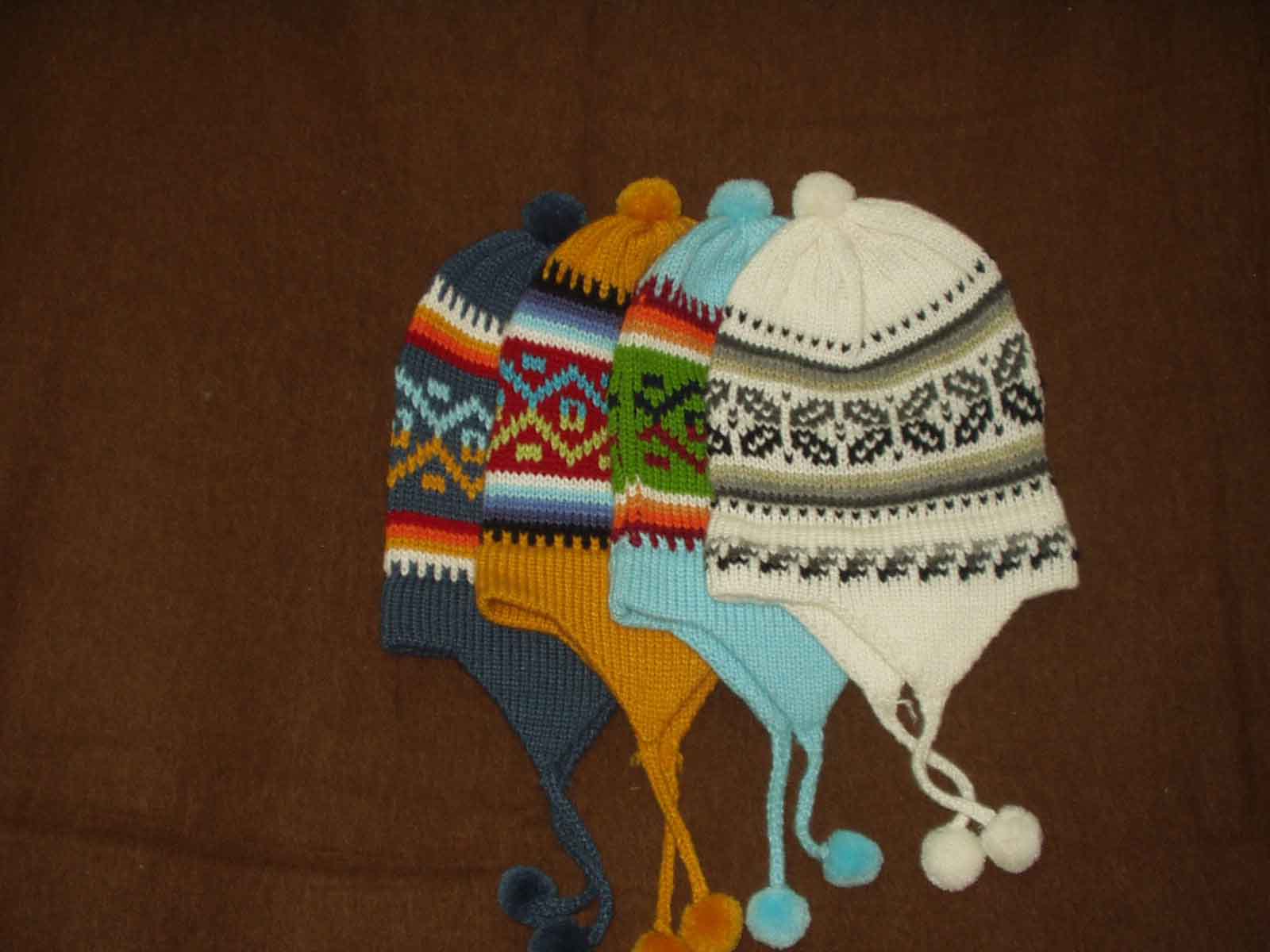
4. The sleeping bag I'm not sure about. If you're doing a lot of serious trekking and mountaineering in Peru, a down bag with a low temperature rating is a good fit, given down's superior warmth for weight in dry cold. However, such sleeping bags are very expensive, in fact pretty much the most expensive item you'll have (up to twice the cost of a backpack, quality boots or a nice jacket). That isn't necessarily a problem in and of itself (you get what you pay for), but it is off putting for me because I find that having too much valuable stuff is a distraction, preventing me from being more relaxed and integrated in an environment where loss or theft is a constant risk, added to my existing tendency to lose or damage things. This is less of an issue where I'm using something all the time, so if something goes wrong "at least I got my money's worth", but in the case of sleeping bags, I'm a confirmed camping wimp and will generally find lodging in a village if at all possible rather than camp.
In summary, worth getting if you're definitely going to be doing significant high-altitude trekking and mountaineering, and maybe not if you're like me and in the mode of: "I'll climb Ampato if I someone will go with me but otherwise settle for something else".
5. While I'm in a brief phase (relative to my lifespan) of being economically comfortable, I'm phasing out most of my polyproplyene in stuff in favour of merino. I've already got myself an ultralight, 140-weight, light-coloured long sleeve top (which, interestingly, Icebreaker has dubbed the 'Inka'), which will probably be the only thing I'll wear next time I'm in the ceja de selva or the jungle proper. I also plan to get a down jacket (with a hood) at some stage, and would be more motivated to do this if Wellington didn't spend so much of the time in the boring temperature range of 8--15 degrees Celsius.
I've also got myself some liner socks and plan to get more. Another thing on the list is a cap made from synthetic material: a cotton cap soaks up sweat like no tomorrow as you plough uphill in the sun and can leave you chilled if the wind gets up, or just clammy.
Tuesday, September 01, 2009
To the Devil's Cave
 The first time I heard the story in the previous post was from Lizbeth's brother Yamil, sitting eating breakfast in the Valle del Fuego in Cabanaconde and plugging him for contacts who could tell me more "ghost stories of the sierra".
Yamil has something of a fascination with things supernatural and was an enthusiatic informant. Among his tales of phantom figures and strange energies, he outlined the odd case of Señor Mendoza. "Why don't you look for the schoolteacher Rogelio Falcon", he advised me. "It was his father-in-law that disappeared"
Later that day I went looking for Rogelio. Yamil had told me that his house was close to a comedor half a block from the plaza, but when I asked in that place, they directed me to a street across the other side of the plaza. While I was poking around there, nervous about intruding on someone's private property, a an elderly señora appeared and I asked her about Rogelio.
"That young man there can take you to him, that one going into the shop", she said, pointing way back across the plaza to a figure that with my much younger eyes I could only just make out.
I wandered across and hailed the guy whom the señora had indicated. Lucio was another teacher at the local secondary school, who was originally from the Tacna region. He nodded in recognition when I explained that I was interested in the disappearance of Señor Mendoza. His understanding of the story was similar to Yamil's, although he added a few more details.
We wandered through the streets of Cabanaconde looking for Rogelio; he wasn't at either of the residences that Lucio knew of, but eventually we tracked him down coming out of the school. Rogelio was tall and lean, maybe in his late forties. He was happy to retell the story of his father-in-law and answer my questions. I have to say, I was taken by how amenable people were to a stranger, a gringo even, appearing at random to enquire into the intimacies of local families .
I shouted Rogelio and Lucio a coke, and we went to sit down in the school yard to talk. Rogelio was sceptical about local tales of ghosts and demons, saying they were "things our grandparents talked about, from when there was no electricity and they took fright in the dark". He didn't really think the devil had lured his father-in-law into the wilderness, either, although he swore that the figure of the devil was clearly marked on the hillside above where they had found the señor. "When we went up there in the morning and found him, the devil was there, plain as day", he assured me.
I was intrigued by the whole story. "Why don't we go up there", suggested Rogelio, as if reading my thoughts. We agreed that we would take a trip up to the devil's cave on Friday, after I had come back from my trek down to the oasis at the bottom of the canyon. I enlisted Yamil to go along as well. Yamil was eager, but nervous. He insisted that if we went, we should aim to arrive at 3 o'clock sharp in the afternoon. This was the holiest time of the day -- the hour Christ died -- and would counteract any malignant powers that might be present.
Friday came around, and to my mortification I had drifted so far into "Peruvian time" that I missed my rendezvous with Rogelio at the school, but I eventually tracked him down. We went to pick up Yamil, who was a little jumpy. He showed me a handful of coca leaves that he was carrying in his pocket as a source of good energy. Then he reached into his other pocket and pulled something out. "Here, Simon, take this", he said. He handed me an entire bunch of garlic.
 We walked for maybe forty minutes uphill and west from the village, through the chacras where animals were grazing, on a route which headed up towards the slopes of Hualca Hualca. Near a big rock off to the left of the pathway, Rogelio stopped. "That's where we found my "father-in-law", he explained.
He also pointed out the shape on the hillside that was supposed to be the devil. But to his bemusement, it was no longer very obvious at all. We stood for about five minutes, changing our position and craning our necks, but try as we might, we couldn't see any configuration on the hillside that really looked like the devil.
Our next step was to climb up to the cave itself, but Rogelio said he was going to go back. He pointed out a trail that ran along the hillside across the other side of a stream, explaining that it was an interesting walk that went near an Incan archeological site; he was going to head that way, and if we took that route now we would just make it back to the village before nightfall.
We said goodbye to Rogelio and he started back. "I think he was afraid", said Yamil. Or maybe he had just got sick of playing the tourist guide and wanted to get home.
As we started off towards the cave, Yamil produced a battered packet of tobacco from his pocket. "You know how to roll these?", he asked. "Sure", I said looking a little bemused. "Well, can you roll one?", he said, handing me the packet. Tobacco smoke would ward off the malignant spirits as we got closer to the devil's lair, he assured me. I went along with it for the first few puffs, but then handed the cigarette over to Yamil. Scrambling up a hill at 3,500 metres above sea level is taxing enough as it is.
 When we got up to the top, we found that there was not one, but several, possible "caves". One was a wide, shallow cleft in the hillside at ground level. There, we found clear evidence of a pago a la tierra, an offering to the earth. There was an empty bottle of wine and other items strewn on the ground, ticker tape of the kind thrown round at carnival hanging from the rock, and in the centre of the opening, a large gob of a waxy substance -- llama fat. In front of the cave was a broad flat stone that looked like it might have been artifically smoothed. From what I've learnt later, this probably served as the mesa or table of the curandero who performed the pago. Around a bend in the rock to the left, was a little pile of animal bones, which from later information I'm guessing were rabbit bones.
Up the rock face to the right was another cave-like opening, narrower and deeper. We scrambled up there, but didn't find anything of particular interest.
Yamil wandered back and forth, scrutinising his surroundings like a professional mystic. "On this side, there's nothing evil", he opined. "I just feel...power". He wandered up and peered at the llama fat. "This place has strong energy", he nodded sagely. "I think this isn't llama fat...it's the fat of a vicuña". I grunted sceptically. Yamil walked round to the side with the rabbit bones. "Oh, I don't like it here", he reported. "This is malign".
We took photos of the hillside at various distances, on the way up and the way down. Eventually, at middle distance, I became convinced that I saw the figure of a face. Meanwhile, Yamil was discovering various creatures and demons appearing at various places in the hillside. We struggled to point them out to one another, but it seemed we were seeing different things.
We only had about half an hour of daylight left, so we decided to head back to the village. Back in Cabanaconde, we downloaded the photos, zoomed in, zoomed out. The photo at the top of this post seems to clearly show a face, if not a demonic one. As we zoomed in on the pictures we had taken inside the higher-up cave, Yamil began to discern a number of details in the rocks around where I was crouched posing for the photo: a grinning cat-like demon here, the face of a soul in torment there.
Yamil was excited by the images that appeared in the photos. "This is a genuine discovery", he assured me. "We can take tourists up there". I was amused, but skeptical. Look long enough at a rocky hillside, and you'll find anything you want, I reasoned.
Yet, when I've shown people the image at the start of this post, they've spotted the "face" almost immediately. A couple who I've shown the upper cave photos to have also spotted the "soul in torment" without too much trouble.
Strange forces at work on the mountain, or figments of overworked imaginations? What do you think?
Monday, August 17, 2009
Señor Mendoza and the Devil's Cave
Señor Mendoza disappeared without warning, in the middle of the night, from his home in the village of Cabanaconde.
His family, including son-in-law Rogelio, a teacher at the local secondary school, searched for him throughout the town and the surrounding fields. But their searches were fruitless: after two days and two nights, Señor Mendoza was still missing.
His family, including son-in-law Rogelio, a teacher at the local secondary school, searched for him throughout the town and the surrounding fields. But their searches were fruitless: after two days and two nights, Señor Mendoza was still missing.
Your father is not dead. He is in the same place where they have been looking for him. They should send the night praying, and scattering holy water, and in the morning they should look again in the same place.
This message from the Spanish curandero was communicated to the searchers back in Cabanaconde, who did as had been instructed.
The next morning, they went out early to search again, on a pathway through the chacras up towards a place called Puqio. There, about forty-five minutes from the village, they found Señor Mendoza huddled under a big rock, below an opening in the mountainside which locals know as the Devil's Cave.

"At first we thought the devil had taken him", says Rogelio. "Now we think maybe he just wandered off in a coma. The place we found him was below the devil's cave, well below. And he he'd walked quite a long way to reach the path, from where he had been on the mountainside. That's where we found his glasses and his blanket".
"But it's true that where we found him, the devil is marked in the rocks of the hillside above. In the morning when we went up there, you could see the form of the devil, plain as day".
Maybe Señor Mendoza had just been absent-mindedly sleep walking. But somehow he survived on the barren hillside, without food or water, for three days and three freezing nights
What is true is that when they brought him back to the village, his wife showed her relief by scolding him: "What were you thinking?", she asked. "Why did you wander off like that and lose yourself in the wilderness?"
The old man looked at her strangely. "But why do you ask?", he said, "when it was you who took me there".
Señor Mendoza insisted that his wife had led him into the wilderness. When he had tried to walk back, she had blocked his path and wouldn't let him leave.
After that, for about a month, the señor kept getting up in the middle of the night and trying to leave the house. His wife, his daughter and son-in-law had to watch out for him, and restrain him when he tried to wander off.
This continued until the family contacted a local curandero. After ascertaining the reasons for the old man's restlessness, the curandero took him back up to the place where he had been found. The curandero performed a ceremony called a pago a la tierra, involving an appropriate mix of plant and animal offerings to the earth. After that, the señor was cured, and he once again slept soundly at night time.
"The curandero said he had left part of his soul out on the moutainside", says Rogelio. "We had to go out there and bring it back".

Tuesday, August 04, 2009
Salkantay Trekked: Third Entry
Into the Valley
Once he woke up, Gelmond did well again, nimbly preparing another meal on his stove, while the light faded in pink washes over the mountains and we shivered as the air sank off the icy slopes above us.

Next morning, I was woken by Hugo and Gelmond chatting in the tent next door. It was still dark, so I buried my head in the pillow and tried to continue sleeping, until I heard the sounds of gear being packed, and voices loudly speculating that they might just carry on and leave Simon in the campsite.
I crawled outside to find ice on the tent, and Hugo and Gelmond nowhere near as advanced with packing up as I had thought. They swore they had heard a huge boom shortly before 5am, presumably a chunk of ice separating itself from one of the glaciers. Hugo said he had taken the somewhat contradictory steps of counting down the average nineteen seconds one has before being swept away by an avalanche, and unzipping his sleeping bag to be ready to make a run for it.
I'd put in earplugs during the night to drown out the annoying drone from Mountain Lodge's diesel generator, and hadn't heard anything.
After breakfast, we retraced our steps from the evening before. It was only fifteen minutes walk downhill before the cold started to dissipate and the trees reappeared.
We gradually wound our way down the valley, the vegetation turning lusher, orchids and bromeliads throwing splashes of colour through the trees. Whenever we found a property with space that looked suitable for camping, we sought out the resident señora to discuss the possiblity of working with us in the future.

Hugo's conversation with each local smallholder went something like this: "Listen, I've got a hotel near Santa Teresa, and I'm going to operate the Salkantay trek. I'll bring groups. You should put some sort of table there; use stones for seats so the tourists can sit down. Whatever you do, don't sell your place. Improve, invest. Is that a kitchen you've got there? We'll bring supplies and cook here; how much do you charge? Do you have mules? Definitely don't sell. Hey, you don't want to sell that bit to me, do you? How much do you want?"
As the sky turned dark, Gelmond stirred himself for one last effort. He lengthened his pace, striding off around the bend and into the distance. I in turn slowed down a little to keep Hugo company, and winced each time the ball of my right foot bore weight and rubbed at its expanding blister.
Finally, with the path becoming flatter and smoother in the moonlight, we rounded a bend and saw twin points of light suggesting -- could it be -- a medium-sized vehicle. I ignored my blister and sprinted the last 200 metres to the village. There was indeed a waiting minvan -- Gelmond had made it just in time and had held up the kombi.
We climbed in gratefully. The twenty-five minutes ride to Santa Teresa was as rough and bumpy as you'd expect on any back country Peruvian road -- but for once, getting thrown around the inside of a minivan didn't give me any cause for complaint.
Once he woke up, Gelmond did well again, nimbly preparing another meal on his stove, while the light faded in pink washes over the mountains and we shivered as the air sank off the icy slopes above us.

Next morning, I was woken by Hugo and Gelmond chatting in the tent next door. It was still dark, so I buried my head in the pillow and tried to continue sleeping, until I heard the sounds of gear being packed, and voices loudly speculating that they might just carry on and leave Simon in the campsite.
I crawled outside to find ice on the tent, and Hugo and Gelmond nowhere near as advanced with packing up as I had thought. They swore they had heard a huge boom shortly before 5am, presumably a chunk of ice separating itself from one of the glaciers. Hugo said he had taken the somewhat contradictory steps of counting down the average nineteen seconds one has before being swept away by an avalanche, and unzipping his sleeping bag to be ready to make a run for it.
I'd put in earplugs during the night to drown out the annoying drone from Mountain Lodge's diesel generator, and hadn't heard anything.

After breakfast, we retraced our steps from the evening before. It was only fifteen minutes walk downhill before the cold started to dissipate and the trees reappeared.
We gradually wound our way down the valley, the vegetation turning lusher, orchids and bromeliads throwing splashes of colour through the trees. Whenever we found a property with space that looked suitable for camping, we sought out the resident señora to discuss the possiblity of working with us in the future.

Hugo's conversation with each local smallholder went something like this: "Listen, I've got a hotel near Santa Teresa, and I'm going to operate the Salkantay trek. I'll bring groups. You should put some sort of table there; use stones for seats so the tourists can sit down. Whatever you do, don't sell your place. Improve, invest. Is that a kitchen you've got there? We'll bring supplies and cook here; how much do you charge? Do you have mules? Definitely don't sell. Hey, you don't want to sell that bit to me, do you? How much do you want?"
The nicest place we saw was Los Andenes, where the local residents had cleaned up and improved ancient pre-Incan terraces that descended in orderly layers to the river, beautifully flat with soft grass, a camper's dream. But by the time we got down to the most popular camping spot at Challuay, Hugo had promised his close collaboration with at least four different families.
At Chaullay we had an extended conversation with the resident señora, who explained that, as elsewhere, tourists could camp for free in exchange for buying something at her shop, or leaving a small donation.
She explained that the residents of the entire route, from Mollepata to Playa Sahuayaco, have formed the Cooperative of Alto Salkantay. The Cooperative advocates for the community and tries to ensure a common front, for example requiring that mules be charged out at no less than S/. 30 per day.
Ten minutes away across the river was the third in the chain of Mountain Lodge hotels. The señora said that the locals felt cheated because they had sold the land to a Peruvian, who had on-sold it to international investors. She said gravely that the relations with the Mountain Lodge people weren't very good, and that there "could be problems". It seemed that there had been all kinds of promises made, such as bringing electricity and building a school, which hadn't yet been delivered on I was having visions of another interesting development studies case study, but we had to move on.
Hugo's contribution was to sing the praises of the Pelton wheel, which his brother Alan had installed at Hugo's Lodge, and which powers the whole property using only the power of falling stream water. He told the señora about a second-hand Pelto that he knew of, going cheap. "You can generate your own electricity", he assured her. He promised to bring her tourists as well.
Another hour, and we prepared lunch in another pleasant grassy area beside a farm house with a shop, pigs and dogs, before heading off on our final stretch. The route on the way to the village of Playa Sahuayaco ran past some basic hot springs at Collapampa, where we dithered for a while. We had heard rumours about a road that descended from this point, and Hugo in particular sniffed the chance of a smoother, more rapid journey to Playa -- though everybody we asked insisted that the road was no quicker than the traditional mule trail.
Across the river above the hot springs there was indeed the end of a road, but the only way across was a 'bridge' of flimsy tree trunks stacked loosely, a couple of metres above some vicious rapids. While we were lingering, some locals came down from the road and stepped gingerly across. But I couldn't see us finding any way to cross with our heavy backpacks. It just wasn't worth risking death for a dubious time saving. We learnt later that there had been a locals had knocked down a more substantial bridge, to stop motor vehicles usurping the arrieros' traditional business carrying cargo up the valley.

It was only day two of the trek, but by mid-afternoon some of us had begun to fray around the edges. Hugo had declared, not without some pride, that he was "completely unprepared" for the trek. He had chortled at my and Gelmond's modern gear: his only nod to convention was a nice soft shell jacket, which he combined with cotton t-shirts, jeans, and a backpack best suited for daytripping. When it got cold at night on the pampa, he begged to borrow my chullo to warm his head. To take his share of the load, Hugo had agreed to carry the 4-man tent. Without enough space in his pack, he carried it along under his arm, and unsurprisingly lost his balance and slipped several times on the way down from the pass. On day two he somehow manged to stuff the tent inside his backpack, which meant that he at least stayed upright.
He also sang the praises of his boots, which he claimed had lasted eight years after he picked them up second hand for a pittance. But as fine a job as they might have done, the Salkantay trek was a bridge too far. On the second morning Hugo noticed that a hole had appeared in the bottom of one boot, and by lunchtime the whole sole had collapsed in. He began to hobble a little, and his feet got wetter with each stream we crossed.

For my part, I was embarassed to find that a large blister had developed on my right foot. Surely my feet weren't that tender -- and weren't my thick, soft, $35 Icebreaker trekking socks supposed to protect them? The best I could do was blame it on the pressure resulting from my backpack's poor weight distribution. To my chagrin, I had to admit Hugo had been right to make us skip the first day of the trek.
As the sky turned dark, Gelmond stirred himself for one last effort. He lengthened his pace, striding off around the bend and into the distance. I in turn slowed down a little to keep Hugo company, and winced each time the ball of my right foot bore weight and rubbed at its expanding blister.
Finally, with the path becoming flatter and smoother in the moonlight, we rounded a bend and saw twin points of light suggesting -- could it be -- a medium-sized vehicle. I ignored my blister and sprinted the last 200 metres to the village. There was indeed a waiting minvan -- Gelmond had made it just in time and had held up the kombi.
We climbed in gratefully. The twenty-five minutes ride to Santa Teresa was as rough and bumpy as you'd expect on any back country Peruvian road -- but for once, getting thrown around the inside of a minivan didn't give me any cause for complaint.
Subscribe to:
Posts (Atom)